When AI support credits run out, a customer may still be waiting for an answer. I want the business to know what happens next before it puts that agent in front of people.
We reviewed the public pricing and billing terms of 100 AI customer-support products. In the official sources we checked, only 7 had a complete explanation of what happens to work already underway at a limit. Some documented policies stopped AI replies, some let an active query finish, and others allowed conversations to continue against a later balance.
For a business promising support to its customers, that choice affects both the bill and who gets an answer. The price of a conversation does not tell you which arrangement you are buying.
Our study at Merge Rocks includes Fin, HubSpot Customer Agent, Gorgias, Ada, Sierra and Decagon, alongside smaller standalone agents. We examined what a buyer could verify before paying. We reviewed published rules; we did not run the agents or check real invoices.
“Per conversation” still needs a charging rule
Across the same 100 products, we found complete explanations of the billing unit for 70. Only 40 fully explained what makes that unit chargeable. A plan can define a conversation without settling which conversations you pay for.
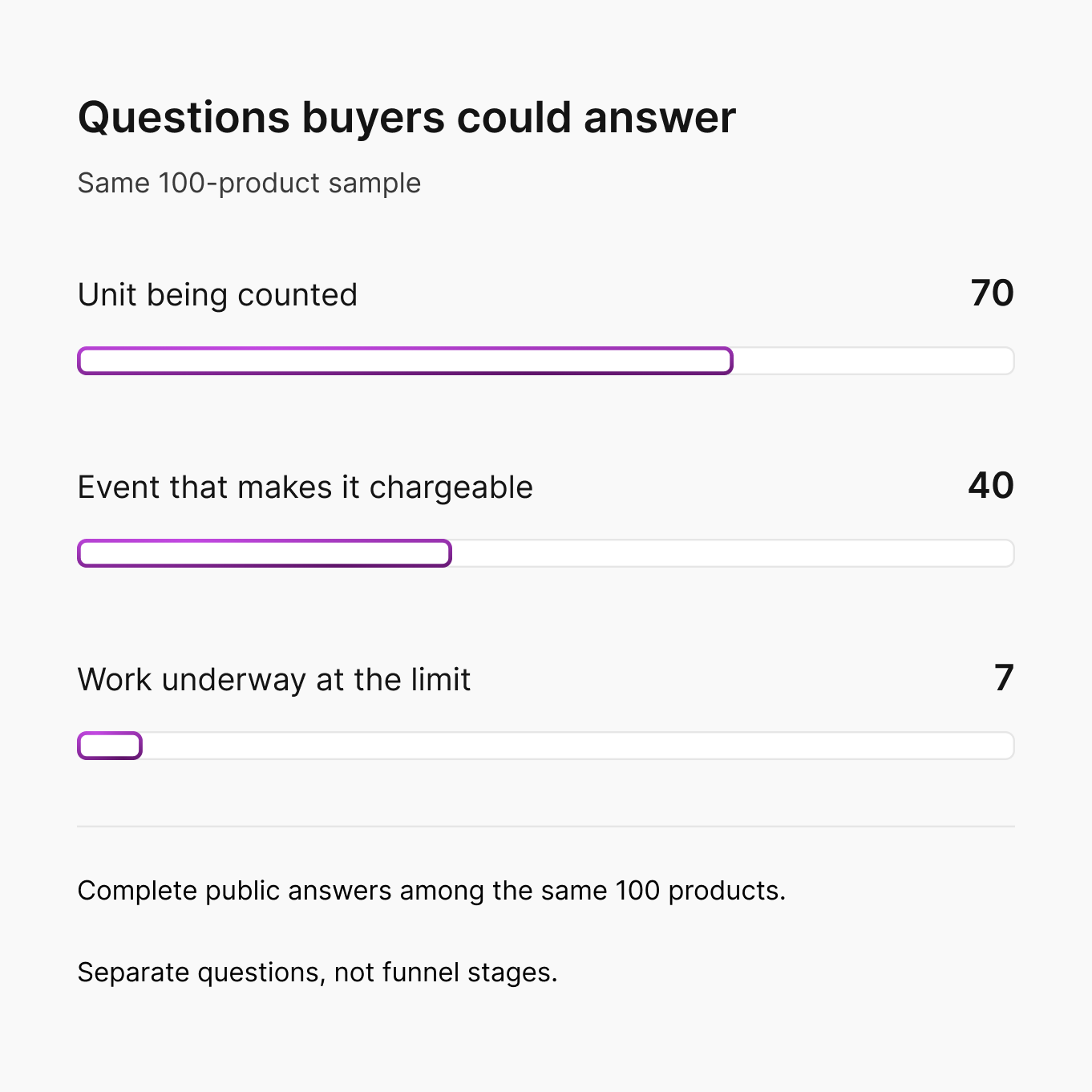
Complete answers among the same 100 products. These are separate questions, not stages in a funnel.
To compare AI customer service pricing models, start with a request your team already gets. Imagine a customer who gets an AI answer, asks a follow-up and then needs a person. A vendor might count replies, a conversation or an outcome. The exchange might also consume a helpdesk allowance. To estimate the cost, you need to follow that request through the rules.
One Gorgias request can use two allowances
The Gorgias Starter monthly offer we reviewed combined a US$10 helpdesk subscription with 50 tickets and a US$30 AI add-on with 30 automated interactions. Both were recurring payments before additional usage.
Gorgias’s billing documentation says that a request fully handled by AI, without human involvement within its 72-hour window, counts as both a helpdesk ticket and an automated interaction. Budgeting for the AI add-on alone would miss the helpdesk capacity that the same request uses.
A handoff follows a different rule: the exchange incurs a helpdesk-ticket charge rather than an automated-interaction charge. That does not make it free. Human, AI or Rule outbound replies can create the billable helpdesk ticket.
A paid outcome can leave work for a person
Fin’s outcome rules include explicit satisfaction, a defined silence condition after an answer, and successful configured Procedure handoffs. Other escalation cases receive different treatment.
For a buyer, the word “outcome” therefore needs a definition. A qualifying handoff can be chargeable while someone on your team still has work to do.
I would compare services using requests the business actually receives: a simple question, a follow-up, a handoff and a returning customer. Then I would check what each service charges for and how much work remains for people. Any savings forecast also depends on answer quality, which needs its own test. I would not put savings into a budget on the assumption that two equally priced outcomes resolve problems equally well.
SleekFlow can charge for a reply the customer never receives
In the SleekFlow Pro WhatsApp offer, Advanced reply generation consumes AI credits, including specified cases where the reply is not sent or delivered.
For example, a person may take over after an Advanced reply has been generated but before it is sent. The generated reply still consumes credits. A newer customer message or a channel delivery failure can produce the same distinction between generation and delivery. Basic knowledge-base replies have a different credit rule.
A forecast based on delivered messages would miss some charges. It also needs to distinguish Advanced processing from Basic replies, rather than assigning the same credit cost to both.
An empty balance does not mean the same thing across products
We found complete explanations of what happens to new work at a limit for 22 of 100 products. For work already underway, the count was 7. Another 4 answers about ongoing work were partial, 85 were not found within our review limits, and 4 could not be resolved because required sources were inaccessible.
- AskYura. The bot stops replying in open chats when the daily limit is reached and alerts human agents. Manage plans
- CustomGPT.ai. A request already in progress finishes because the limit is checked when each request starts. Usage limits
- eesel AI. Work already in progress finishes when the monthly cap on extra spending is reached. Pricing overview
- Fin. Under Fin’s general chat rule, reaching the configured outcome limit triggers a handover when the customer next replies. Usage alerts and limits
- REVE Chat Wize AI Agent. An already billed conversation can continue within its original 24-hour window, even at zero balance. Pricing guide, FAQ 16
- SleekFlow AgentFlow. An Advanced reply already in progress finishes and consumes its full credits, even if the balance goes negative. AI Wallet
- tawk.to AI Assist. AI can continue an open chat after credits run out, with excess usage deducted from the next balance. Message credits
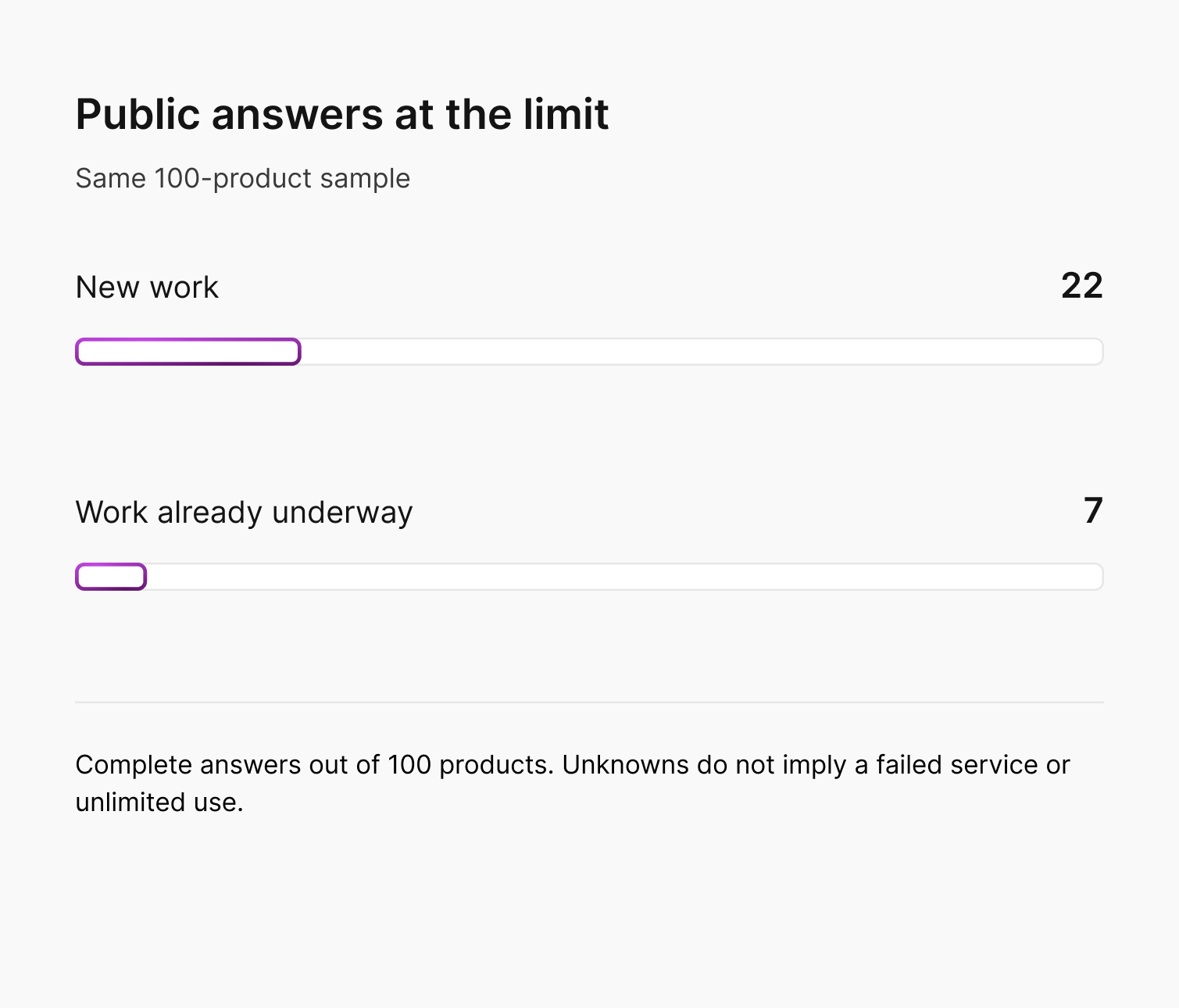
For 30 products, we could not establish whether the relevant allowance or limit applied. We kept that uncertainty in the 100-product denominator; we did not treat it as unlimited use.
tawk.to can continue the conversation against the next balance
For AI Assist Growth, tawk.to’s overage guide says the AI stops joining new conversations after available credits run out, until credits are purchased or subscription credits reset. Existing conversations can continue as excess usage, deducted from the next credit balance.
Keeping an active conversation going can reduce the balance available after the next purchase or reset. Optional automatic top-up is a separate setting; its availability does not mean it is enabled by default.
AskYura stops AI replies in existing conversations
AskYura’s plan guide, reviewed for its Starter website-chat offer, applies the daily limit to both new and existing conversations. At the limit, the bot can no longer respond and human agents receive a notification so they can take over.
The customer may still be in an open chat, with no further AI reply available. The business needs to assign who takes over and what happens outside working hours. A notification does not establish that someone is available to help.
CustomGPT.ai lets an active query finish
For the Standard website-chat offer, CustomGPT.ai’s usage guide says the limit is checked when a query starts. An active query completes; new queries stop when the allowance is exhausted.
Finishing one query does not promise that the whole conversation can continue. The statement also does not, by itself, establish an overage or debt rule.
SleekFlow’s Advanced processing adds another case. A reply already started can finish and consume its full credits. Concurrent work can leave a negative balance, which the documentation says is deducted from later top-up or plan credits.
If support must continue, the team needs to accept the terms for additional use. A strict budget needs an agreed stopping rule and a next step for the customer. I would settle that before launch, including the treatment of a reply already being generated.
The remaining 93 products are not 93 services that failed a live test. Our result concerns the public answers we could establish, not how those products performed.
Billing help answered questions the pricing page left open
For the same 74 products with a dedicated pricing entry we could assess, we compared that entry alone with the wider official sources we inspected.
The pricing page alone explained the billing unit for 50 of 74 products. With official documentation included, we could fully answer that question for 62 of 74.
The event that makes a unit chargeable was fully explained for 16 of 74 on the pricing page alone and 36 of 74 with official documentation included.
For work already underway at a limit, those counts were 2 and 6 of 74.
These are two reviews of the same products using different sets of sources, not a change over time.
A condition missing from the pricing page may still be explained in a billing guide. Our review found published answers that a comparison restricted to pricing pages would miss. It did not measure how easily a buyer could find them.
This comparison covers a smaller group than the full study. Product-page pricing sections, marketplace offers, sales or legal pages used in place of pricing, and inaccessible entries were outside it.
Check which spending a cap actually controls
Among 100 products, 15 had complete explanations of usage alerts, 27 of a defined usage stop, and 5 of a monetary spending cap. We recorded whether a mechanism was available separately: a complete explanation could include an explicit statement that it was unavailable.
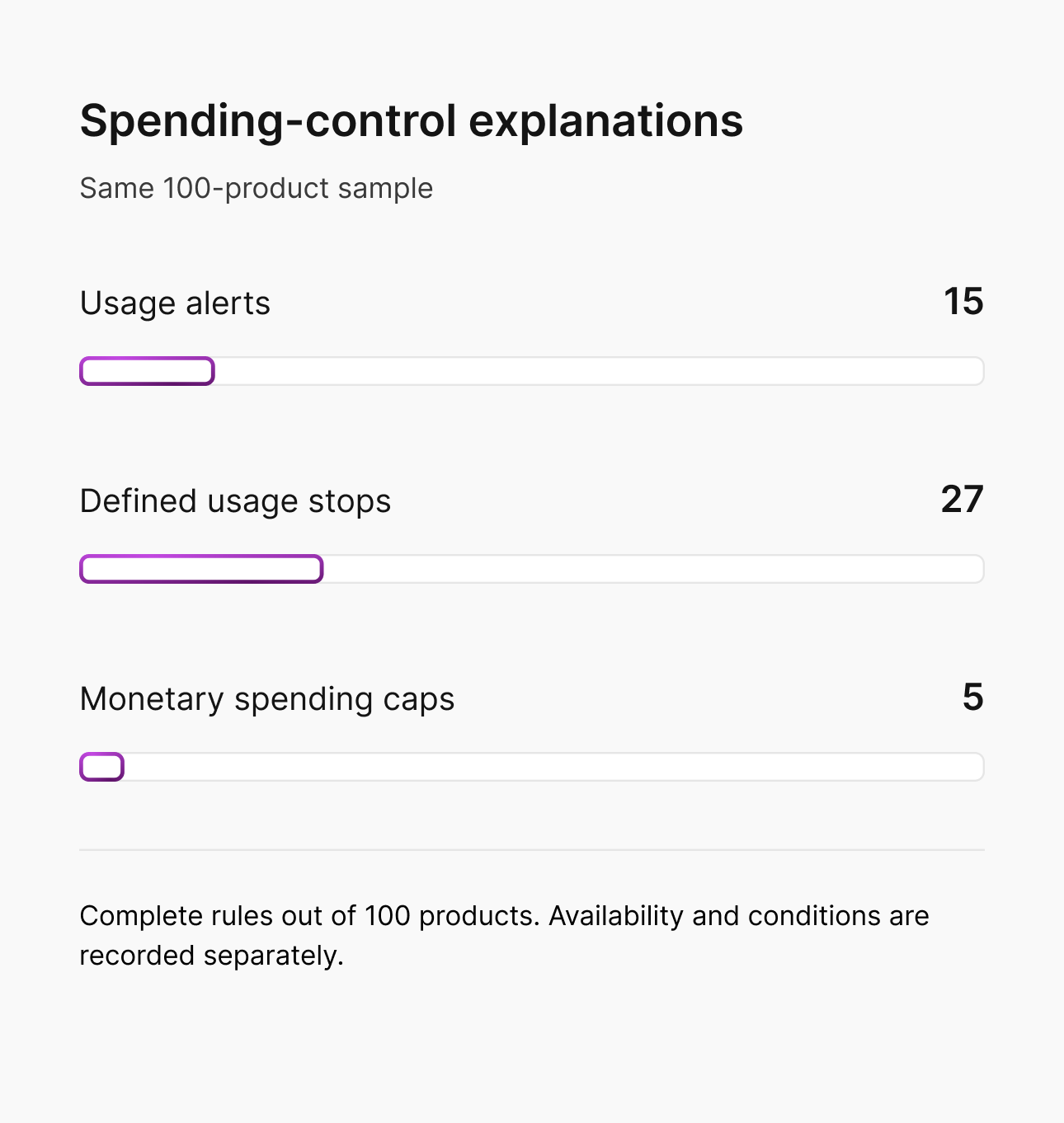
These counts measure complete explanations. They do not mean each feature is offered or enabled.
An alert tells someone about consumption. A stop blocks a specified activity. Auto-recharge buys more capacity. Before relying on any of them, check which charges can continue.
SleekFlow’s monthly auto-top-up budget controls automatic credit-pack purchases. A pack is not bought if the purchase would exceed that budget. The limit does not cover the platform subscription, WhatsApp charges, manual purchases or every other cost. Work already running has its own debt treatment.
Crisp’s Hugo migration guide describes a per-conversation spending budget with escalation. That concerns one conversation. A workspace-level budget concerns a different amount of activity.
For either control, check which balance it covers, when it takes effect and which charges sit outside it. We did not test whether concurrent requests could cause spending to exceed a published limit.
Testing may spend the credits you planned to use live
Only 16 of 100 products fully explained whether testing consumes paid capacity or a separate allowance.
Deacon’s Starter pricing explanation excludes Playground and localhost replies from its answer allowance. Failed replies are excluded too; ordinary follow-up AI replies count again.
Chatflow’s Playground guide says Playground messages use the same message credits as live chats. Its precise credit conversion and charge exceptions remained incomplete in our review.
For a team repeatedly checking a knowledge base before launch, these rules lead to different budgets. Chatflow’s Playground use can consume credits intended for customers; Deacon’s specified test replies are excluded.
I would include those test replies when estimating the capacity left for launch. A sandbox can separate testing from customer-facing chats while using the same paid balance.
Subscription credits and top-ups can expire differently
For 48 of 100 products, we could fully establish what use was included. That count covers stated quantities as well as explicit answers that no use was included or that use was unlimited.
Cekat.AI’s English terms show why a single allowance figure is not enough. Unused package credits expire at the end of the billing cycle without rollover. Separately purchased credits do not expire and carry forward.
Calling that simply “credits expire” would give a buyer the wrong picture. We checked reset, expiry, rollover and purchased-credit expiry separately. For each question, we distinguished products with a relevant balance from those where we could not establish whether the question applied. An unknown allowance was never entered as zero.
Before renewing, a buyer needs to know which balance remains usable and which agents or channels share it.
Give buyers the consequence beside the allowance
The detailed billing guide can carry rates and exceptions. The immediate consequence of running out belongs beside the allowance. For an offer following tawk.to’s documented rule, it could read:
When available credits run out, AI stops joining new chats. Existing chats can continue, and their excess credit use is deducted from your next balance.
This is our illustrative wording based on the rule, not a vendor quotation. A clear link can take the buyer to the detailed rates and exceptions.
For a team building its own AI offer, I would check four things before signing off that explanation:
- Follow a request through the bill. Define what triggers a charge, including relevant follow-ups, failed replies and handoffs. Include mandatory platform, seat and add-on payments.
- Separate recurring allowances from trial grants and purchased credits. Explain periods, shared balances and expiry.
- Agree what happens to new requests, active conversations and replies already being generated at a limit. Assign the customer’s next step, including outside working hours.
- Explain the scope of alerts, spending limits and testing. State what each control covers and which charges it leaves outside.
In a SaaS design and development project, these decisions have to reach the pricing page, usage counter, warning and purchase confirmation. A designer needs an agreed rule to explain. A writer cannot resolve an undecided overage policy by making the pricing card sound clearer.
How we reviewed the products
We looked for paid, hosted AI agents that could answer customers by chat or email without a person approving every reply. That included standalone agents and agents built into helpdesks. We left out tools that only help human agents write replies, internal IT bots, voice-only products and general AI tools without a dedicated customer support offer.
We built the candidate list from software directories, published comparisons and six search queries. In the first round, we checked 144 candidates and collected records for 90 products. After reviewing the sources, we kept 88. We couldn’t confirm that one product offered eligible text support, and the other shared a confirmed parent company with a product already in the study.
We then expanded the list to 225 candidates and used the same eligibility rules and selection order to choose 12 more before assessing their billing terms. That gave us 100 product families. We counted each family once and kept one representative where we could confirm shared ownership. Some ownership links remained unconfirmed.
For each product, we reviewed the first standard paid offer that supported eligible chat or email. We used monthly billing where it was available and included any required subscription, seats or add-ons. We checked official pricing pages, billing guides and public terms in English on November 2–5 and November 17, 2026.
We used the same 29 questions across the study. An answer counted as complete when the official sources explained the rule for the plan and channel we reviewed. A pricing page might say it charges per conversation, for example, while leaving open whether the charge applies when the agent replies or when it resolves the issue. Those were two separate questions.
- 70 of 100 fully explained what unit they count toward the bill, such as a reply, conversation or outcome.
- 40 of 100 fully explained what makes that unit chargeable.
- 7 of 100 fully explained what happens to work already underway when a limit is reached.
All 100 products stayed in each count. We recorded partial answers, conflicting terms, answers we couldn’t find and sources we couldn’t access separately. Four products had access problems on at least one of the three questions. When we repeated the count with the remaining 96, the numbers of complete answers were still 70, 40 and 7.
The Macha and Asks pricing indexes and Gupta’s AI-pricing study cover prices, billing models and credit rules. Our review also checked which answers buyers could find on the pricing page itself and which took a look at the billing docs. Macha pricing index · Asks pricing index · Gupta’s AI-pricing study
Frequently asked questions
Did you include products that require a sales quote?
Yes. “Contact sales” can explain how to obtain a price while leaving its amount unknown. It does not answer the questions about charge events or limits. We did not exclude a qualifying product because it lacked a public numerical price.
Can the study identify the best or cheapest agent?
No. We did not test a common workload, answer quality, real invoices or buyer comprehension. We do not combine the findings into a vendor score or rank unlike billing units by price.
What should a buyer confirm before paying?
Each observation belongs to its captured date and offer. Check current official terms and the agreement for your plan and channel. If an important condition remains unclear, I would ask the vendor to confirm it in writing and check that answer against the commercial offer. A suitable service can stay on the shortlist while those questions are resolved; I would postpone payment if a material part of the bill or support policy still depended on an assumption.
Before I Scale Acquisition, I Want Buyers to Explain the Bill
A buyer may recognize “per conversation” and still misunderstand which conversations they will pay for.
I would give a prospective buyer a realistic support workload, including some testing before launch, and ask which plan they would choose and what they expect to pay. Their explanation should also cover what happens if credits run out during a conversation. They need to find those conditions themselves. Pointing out the right sentence would hide where the page leaves them guessing.
A confident answer that conflicts with the terms would be especially useful. The person may believe Playground use is free, or that an active chat can continue without using another balance. The team would have a specific misunderstanding to address. I would revise the explanation and repeat the task to see whether the buyer’s answer changes.
Our research tells us which answers we could establish from published sources. It does not tell us whether someone choosing a plan understood them.
After changing the page, I would follow the results through to payment and questions about unexpected charges, alongside sign-ups. More leads would not be enough for me to increase acquisition spend if new customers were still misunderstanding what they had bought.
Before putting more budget behind the page, I want evidence that buyers can explain the bill they are signing up for.