0
Table of Contents
Telegram mini apps 2026 monetization guide. How to earn from Telegram mini apps?
You don’t need a huge budget or a massive team to succeed. All you need is a smart idea and good execution.
Yes, you can absolutely make money with Telegram mini apps in 2026.
These in-chat web applications can give you an opportunity to monetize through in-app purchases, advertising, subscriptions, and more.
A mini app can leverage the huge Telegram user base (over 1 billion MAUs) and built-in Telegram integrations like payments to generate real revenue.
In fact, creators are already earning income via Telegram’s in-app currency (called Stars) for digital goods, and via native ads that blend seamlessly into the Telegram UI without disrupting users.
How? Read on.
We’ll give you advanced strategies to monetize your Telegram with tips from our front-end team at Merge.
(Bonus: If you need help with product design or frontend development, reach out and tell us your vision and goals.)
What are Telegram mini apps?
A Telegram mini app is essentially a web app that runs inside Telegram (as part of a bot chat). No separate install needed.
Users launch these mini apps via a chat button, link, or the Telegram menu (like the attachment menu in chats), and get a rich interface right within the Telegram app. Under the hood, a mini app uses standard web tech (HTML, CSS, JS) plus the Telegram Bot API and Web Apps API for deeper integration.
Telegram mini apps evolution from launch to 2026
Telegram introduced Web Apps for bots in 2022, and the concept of “mini apps” took off. Early Telegram mini apps (often simple Telegram webapp games or crypto tools) gained traction by offering quick interactions – for example, many users’ first mini app experience was earning crypto tokens or exploring Web3 services in-chat.
Since then, Telegram has heavily invested in mini app capabilities. Here’s a timeline of key mini app updates:
2016–2017 | Telegram introduces Bot-powered games (early HTML5 game bots). Monetization is limited (no in-app payments yet). |
2022 (Apr) | Bot API 6.0 launches Web Apps – the birth of Telegram mini apps. Bots can open web UI in chats. Initially used for simple games, quizzes, etc. |
2022–2023 | Rapid iteration: Added dialogs, Telegram menu integration (attach menu bots), support for direct launch links, and UI APIs (theme, popup, QR scan) to improve mini app UX. Early mini apps often centered on crypto tasks or mini-games. |
2024 (Jun) | Telegram Stars were introduced as an in-app currency for digital goods and services. Bots/mini apps can now sell e-books, game items, etc. Users buy Stars via in-app purchase (App Store compliant), and devs withdraw earnings in crypto (Toncoin). This was a game-changer for monetization. |
Late 2024 | Major UI upgrades: full-screen layout, landscape mode, home screen shortcuts, persistent storage for sessions, and subscriptions with Stars support. Telegram itself launched a Stickers Mini App (for creating sticker packs) to showcase these capabilities. |
2025 | Telegram crosses 1 billion MAU – mini apps gain a huge potential audience. Telegram adds an “Apps” section in search for discovery (making mini apps easier to find). Many new mini apps emerge across industries (finance, e-commerce, edtech, etc.). Telegram’s official Wallet bot and TON blockchain integration drive more Telegram integrations of crypto services into mini apps. |
2026 | Mini apps are a core part of the Telegram ecosystem. Advanced features (like AR filters, AI bots inside mini apps) are appearing, and performance is optimized for even low-end devices. “Super apps” strategy: Telegram positions itself like WeChat, with mini apps for everything from banking to gaming. |
Basically, Telegram mini apps in 2026 are full-fledged web applications inside a messenger that’s used by millions daily. They offer a fast track to users, and, as we cover next, multiple ways to monetize those users.
Why Telegram mini apps are a big opportunity in 2026
What is Telegram app for? Launching a mini app means bringing your service directly to where your audience already hangs out. Instead of fighting for mobile app installs, you can tap into Telegram’s huge network with virtually zero friction.
- Massive built-in user base
Telegram exceeded 1 billion active users in 2025. Your mini app can be one tap away from all of them without any app store barriers. Mini apps can go viral through chat shares and communities, giving you organic growth loops.
- Experience
Users launch your mini app instantly, without installs or sign-ups. They’re already logged in via Telegram. The UI opens inside their familiar chat window, creating trust.
For example, a mini app can autofill the user’s name and theme to match Telegram’s look, making it feel like a natural extension of Telegram.
- Multiple revenue streams
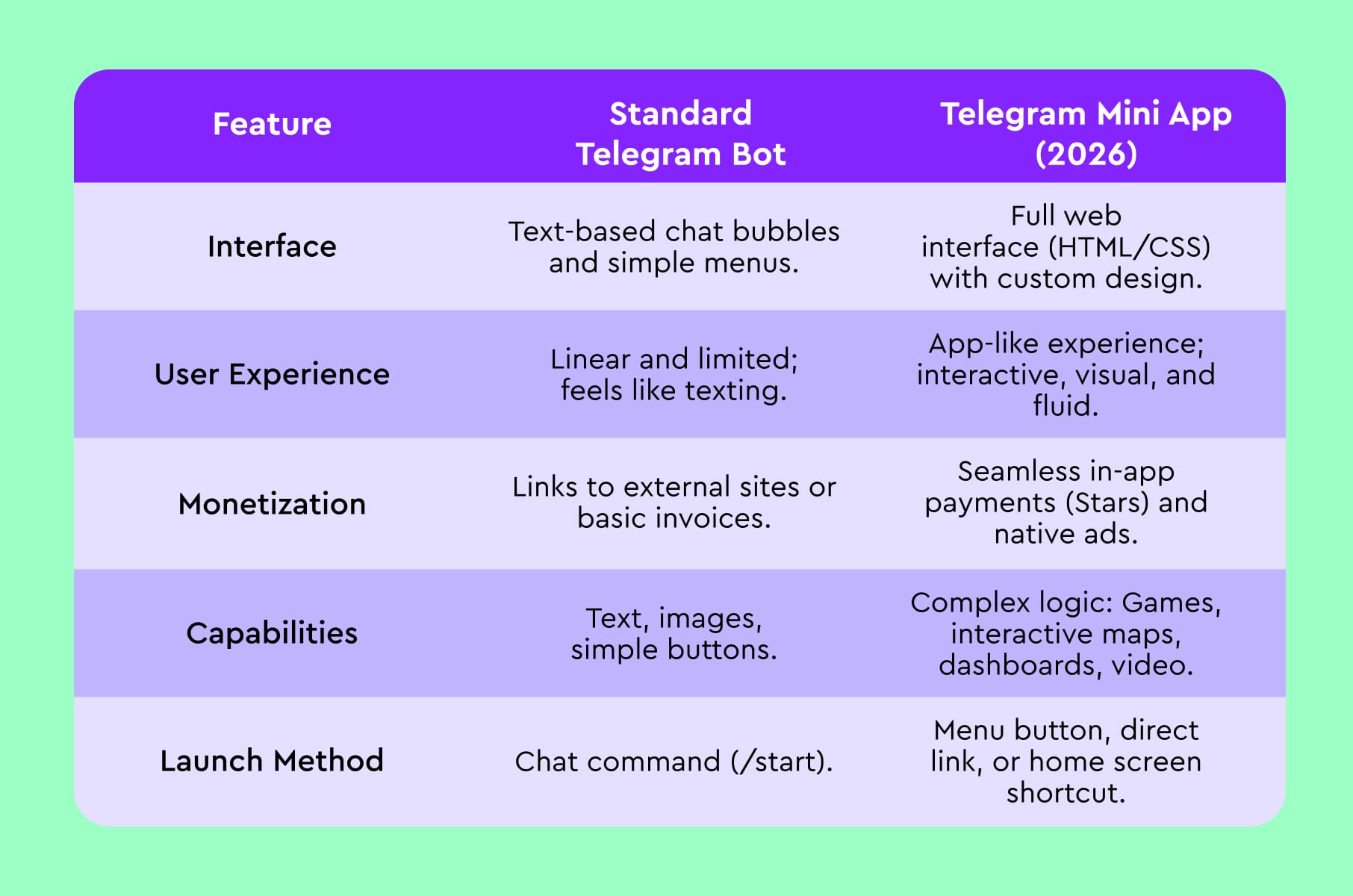
Unlike basic bots, Telegram mini apps have many more options for making money. You can sell digital goods or premium features directly (Telegram now supports one-tap payments), offer subscriptions, display ads, or even integrate affiliate offers. Few platforms allow all these in one place.
- Integrations and features
Mini apps aren’t limited to text responses; you can create rich, interactive interfaces: think e-commerce catalogs with product galleries, games with graphics and sound, interactive forms, maps – all inside Telegram.
The Telegram API and Bot platform provide hooks for notifications, group chat integration, and even accessing the user’s Telegram menu for attachment-based apps.
New APIs allow things like real-time collaboration in groups or using device features (e.g., location, camera via Telegram).
- Faster time to market and lower costs
Building a mini app is typically faster than a full native app. You can use web frameworks and one codebase for all platforms. There’s no App Store review to wait on, no separate iOS/Android development – push updates anytime.
In fact, a simple MVP mini app can be built in weeks or even days, and if you partner with experts in MVP development, you accelerate even more. This kind of speed will have you testing ideas and starting to earn quickly, then iterating.
- Engagement
Many mini apps incorporate referral programs or group features to encourage virality. Viral sharing inside chats can fuel exponential growth without huge marketing spends. For instance, a quiz mini app can prompt users to “challenge friends” in groups, driving new users into your funnel.
Next, let’s focus on turning those users into revenue.
How to monetize Telegram mini apps (earn money inside Telegram)
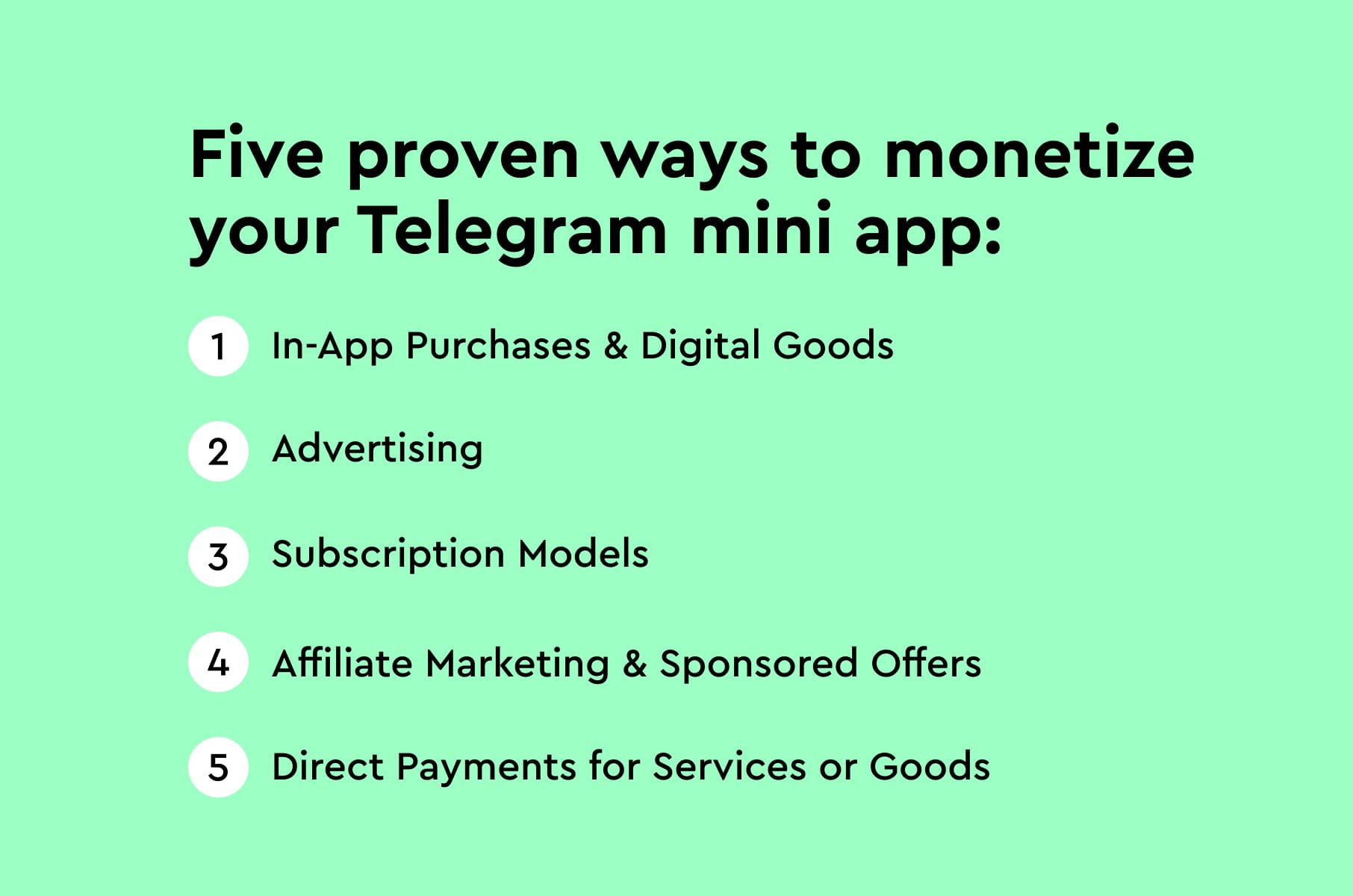
Below are five proven ways to monetize your Telegram mini app (with real examples and tips):
In-app purchases and digital goods
You can sell products or premium features directly inside your mini app.
Telegram’s Bot Payments API has long allowed credit-card payments via providers like Stripe, but the game-changer is Telegram Stars – an in-app virtual currency launched in 2024. Stars let users pay bots for digital goods and services with one tap.
Users buy Stars (via Apple/Google in-app purchase or via @PremiumBot) and spend them in your app. This system is fully compliant with App Store policies, meaning you can monetize on iOS/Android without issues.
Subscriptions are also supported: you can offer recurring plans through Stars (Telegram added subscription APIs so bots can track renewal, etc.).
Yes, Telegram games can also pay real money, just indirectly.
If your mini app is a game with winnings (e.g., a trivia game paying crypto), you’d use Stars or an external wallet to reward users. Some mini game bots run on play-to-earn models where top players get cryptocurrency or tokens (e.g, TG Trivia awards USDT prizes to winners).
Just remember, Telegram itself doesn’t pay users to play games – the payments come from the bot/app operators.
Advertising inside your app
One of the most popular monetization paths is integrating ads into your mini app’s interface. But it’s not those obnoxious pop-ups, no-no. We’re talking native-style ads that feel like part of the app.
Several ad networks now specialize in Telegram mini app ads, including Monetag, RichAds, PropellerAds, ExoClick, and others. These networks serve ad units that look like Telegram messages or simple banners, often appearing at natural breaks (e.g., between game rounds or content sections).
The appeal is that even a free mini app with lots of users can generate a steady income from ad impressions and clicks.
For instance, RichAds offers a native ad format for mini apps that consists of a small image and text, appearing as a snippet above your content.
Monetag’s Rewarded Interstitial ad is another example – it’s like a message that pops up, and users can dismiss or click for a reward; publishers see average CPM rates around $2+ for such formats.
Our tip would be to make your ads tasteful. And test their placement.
With the right balance, ads can significantly boost your revenue while keeping users happy. Many mini app publishers report that users have less “ad blindness” in Telegram, since these ad formats are relatively new.
Subscription models
If your service offers ongoing value (news, courses, premium tools), consider a subscription inside Telegram. You can do that by combining Telegram Payments API and Stars.
This could mean a monthly membership fee paid via Stars (Telegram handles the payment and can notify your bot of renewal status).
You might also manage subscriptions via external systems (perhaps have the bot send an invoice each month via a payment provider), but using Telegram’s built-in flow will be smoother for users.
Some channels and bots use a hybrid approach: they offer a mini app UI for content and use Telegram’s Pay-to-Join feature for channels or paid bots for recurring fees.
Important: If you go the subscription route, make sure to deliver consistent value and remind users of upcoming content.
Affiliate marketing and sponsored offers
Mini apps can also earn money by referring users to third-party offers and earning commissions or fees. This is essentially in-app affiliate marketing.
For instance, if you run a travel booking mini app, you might integrate with an airline or hotel affiliate API – when a user books via your app, you get a cut.
Or even simpler, your mini app can occasionally prompt users with special offers and use referral links.
Sponsored content is another variant: a brand pays you to feature something in your mini app’s content. We’ve seen mini game apps partner with crypto projects to sponsor in-game challenges (the sponsor provides prize tokens, and the app gets compensated).
One other idea is to create a tasks wall in your mini app: users can choose to complete offers (like a survey, sign-up, or visiting a site) in exchange for an in-app reward (like extra points).
This is similar to how some free mobile apps monetize, and it can work in Telegram too.
Direct payments for services or goods
If your mini app ties into a business, you can simply use it as a sales channel.
For example, a retail brand could let users browse a product catalog in the mini app and pay to order (physical goods purchase via Telegram’s payment providers).
Or a SaaS company might offer a Telegram mini app as a client for their service and charge for upgrades or usage beyond a free tier.
Telegram supports Payment APIs with many providers (Stripe, PayPal, etc.) for one-time payments, and these can handle physical goods transactions (with shipping info, etc.).
An example from real life: some restaurants integrated mini apps to let users order food in Telegram and pay via credit card or Apple Pay – effectively using Telegram as an ordering interface.
Another example is e-commerce mini apps (Telegram has ones for buying sneakers, electronics, etc.), where the checkout happens inside the chat.
While this is not a new monetization method per se (it’s just commerce), it’s worth noting because it’s your revenue directly.
Pro tip: Make sure to enable Telegram’s Wallet integration or connect the TON wallet if you want to accept crypto payments easily.
FAQ: More earning questions answered
If you still have specific questions related to how to earn from Telegram mini apps, we have tried to answer some of the most popular ones in the next section.
How much does Telegram pay for 1K views?
Telegram itself doesn’t pay for views – it’s not like YouTube with a creator fund. However, if you’re showing ads (either via Telegram’s official channel ads or your own sponsors), your earnings per 1,000 views will depend on advertiser rates and your niche.
For instance, channels in broad niches might only get $1–$3 per 1K views, whereas a highly targeted finance or crypto channel can command $10–$25+ per 1K views from sponsors.
Those figures come from typical deals on Telegram ad marketplaces. If you enable Telegram’s official ad platform on your channel, you receive 50% of the ad revenue for ads shown to your subscribers.
There’s no fixed payout per view, but some channel owners report making a few hundred dollars per million views in certain niches, while others make much more with direct sponsorships. The quality and location of your audience matter a lot – views from high-income countries and engaged communities yield higher ad offers.
In a mini app context, “views” translates to impressions or usage – so focus on a valuable audience.
The good news: if you have even a few thousand active users, you can monetize effectively by choosing the right methods (as covered above).
How many followers (users) do you need on Telegram to make money?
There’s no strict minimum – you can start monetizing with any user base, but obviously, more users = more earnings potential. For official Telegram channel ads, your channel needs at least 1000 subscribers to qualify.
That’s the threshold to begin earning from Telegram’s ad platform (and you must comply with their terms).
For sponsorships or affiliate deals, many advertisers look for channels with a few thousand views per post as a baseline. Ad networks like Monetag or RichAds have no minimum user requirement – even a brand new mini app can integrate their SDK.
However, meaningful revenue will likely require a stable user base. As a ballpark, if you have ~5,000 daily active users in your mini app and you show a couple of ads or get a small percentage to make purchases, you’ll start seeing the dollars add up.
Which app is best for earning money? (Which mini app should I build?)
The “best” idea for earning money on Telegram is one that intersects high user interest with a monetizable use case. Some of the top-earning mini apps fall into these categories:
- Games and entertainment (high engagement = lots of ad impressions and potential in-app purchases, e.g., trivia games, casual games).
- Finance and crypto tools (users are willing to pay for premium features or you earn via transaction fees, e.g,. trading bots, crypto wallets,).
- Utilities that save time (could charge a subscription, e.g., a mini CRM or job board inside Telegram), and E-commerce or marketplace apps (direct sales).
- In 2026, we’ve also seen AI-powered mini apps (like AI chat assistants, image generators) that attract users and could monetize via subscription for full access.
Our advice: build a mini app that aligns with your industry or passion, but think early about how you will monetize. If you choose gaming, plan for ads and in-app purchases. If you choose a utility, plan for a freemium model or B2B revenue.
That’s also another way to “earn from mini apps” – build one that a big brand wants to sponsor or acquire.
Conclusion
From our experience, monetization on Telegram (and not just Telegram, to be honest) is directly tied to user engagement – the more value and fun your app provides, the more opportunities you have to earn from each user, whether via ads or purchases.
Audience + distribution + monetization
This is how Telegram mini apps work in 2026, if you want to make some money.
They allow startups and businesses to deploy products directly into a thriving social platform with minimal friction.
We answered the key question in the beginning: Can you earn from Telegram mini apps? The answer is a sure yes, whether through in-app purchases, subscriptions, ads, or services, founders are generating real revenue.
The playing field is also leveling: you don’t need a huge budget or a massive team to succeed. With a smart idea and good execution (plus maybe a little help from a skilled frontend development partner), you can launch a mini app that taps into Telegram’s billion-strong network.
And always stay updated on Telegram’s platform changes; the company is actively evolving mini app features, which means new opportunities (or new rules) can emerge. For example, if Telegram introduces an AI API or better app discoverability, be ready to use it.
Internal reads
- How to build a Telegram mini app – your Telegram mini apps guide
Our comprehensive 2025 guide with a step-by-step breakdown of development stages, tech stack choices, and even live code snippets for Telegram mini apps. A great starting point if you want a deeper technical dive. Read more »
- What is the difference between Telegram mini app and Telegram bot?
Not sure if you need a simple bot or a full mini app? This article compares their capabilities, monetization scope, development effort, and use cases. It will help you choose the right approach for your goals (or how to combine both). Read more »
- What is the best tech stack for Telegram mini apps development?
A detailed look at the tools and frameworks to use when building mini apps. We discuss front-end options (React, Vue, etc.), backend languages (Node, Python, Go…), database choices, and integration tips like using the Telegram Bot API and TON Wallet SDK. Essential reading for planning your development stack. Read more »
- Guide to building a crypto Telegram mini app
Focused on Web3 mini apps, this guide walks through building a crypto-centric Telegram mini app. Discusses TON integration, token reward mechanisms (like tap-to-earn games), and community engagement features unique to crypto mini apps. Read more »