0
Table of Contents
Are Single Page Applications bad for SEO? Master SPA SEO in 10 minutes
You can get a single page app SEO strategy to work today. It just requires the right approach.

Single Page Applications (SPAs) are not inherently bad for SEO.
You can absolutely get a single page app SEO strategy to work today. SPA SEO just requires the right approach.
Modern search engines can index JavaScript-driven content, but you need to optimize your SPA’s structure and performance so search crawlers can easily find and digest your content.
If you wanna master SPA SEO in around 10 minutes, our article is the right source for you. We’ll explain what SPAs are (and how they’ve evolved), the key challenges of SPAs for SEO, and exactly how to optimize SEO for single page applications.
(Hint: it has to do with making your app as fast and crawlable as possible.)
As a friendly reminder, Merge specializes in user-centric front-end development – if you need any help implementing these tips, our team is here. Now, let’s dive in!
What is SPA in SEO?
SPA stands for Single Page Application. In the context of SEO, a single page application is a web app that loads a single HTML page and uses dynamic JavaScript to update content without full page reloads.
This architecture makes the web app feel fast and fluid for users (similar to a native app), but it can introduce SEO complications if not handled correctly. SEO SPA (or SPA and SEO) refers to the practice of optimizing these single-page apps so that search engine crawlers can successfully crawl, index, and rank their content.
In other words, SEO for SPAs means ensuring that even though your site is running on dynamic scripts, search engines still see all the meaningful text, links, and meta information they need.
(Note: Some people search for SEO for ASP, thinking of single page apps. To clarify, SPA refers to Single Page Application – unrelated to the old ASP technology.)
Example:
Imagine a SaaS startup that built their marketing site as a React SPA. The site looks like a regular multi-page website to users, but under the hood, it’s one page dynamically rendering different sections.
SEO for single page applications like this means making sure Google can see the content of each section (Home, Features, Pricing, etc.) as separate “pages” for ranking purposes. The goal of single page application SEO is to have each view discoverable and optimized just as it would be on a traditional static site.
How have single page applications evolved?
Single Page Applications have come a long way. Originally, SPAs rose to popularity because they allowed faster interactions: instead of loading a whole new page from the server on each click, the SPA loads once and then fetches data on the fly, updating the view. This was a game-changer for web apps like Gmail or Trello that feel app-like.
However, early SPAs (circa 2010s) had downsides: large JavaScript bundles leading to slow initial loads, and search engines struggling with content rendered only in-browser.
In 2025, single page app optimization has changed. Modern SPA frameworks and architectures have introduced solutions like server-side rendering (SSR), static pre-rendering, and hydration to counter those initial drawbacks.
For example, frameworks such as Next.js, Nuxt, Remix, and SvelteKit allow developers to pre-render content on the server, so the user (and the crawler) gets HTML content immediately, with JavaScript taking over after.
Our SPAs vs MPAs vs Islands guide explains how modern front-end solutions combine the best of both worlds to improve speed and SEO.
What we are trying to say is – SPAs in 2025 can be fast and SEO-friendly if built with the right tech.
For instance, React 19 introduced server components and streaming, meaning a React app can now send down HTML content that search engines read easily.
In fact, Google loves React now – when using frameworks like Next.js (built on React) and Server Components, what is React JavaScript outputting? It outputs pure HTML that Google bots can read easily.
Our experience has been that projects adopting these modern SPA techniques score much better on Core Web Vitals than those stuck on legacy all-client-side SPA models (we discuss this in What is React.js in 2025) if you want to learn how React’s new features boost SEO).
Key challenges of SPAs for SEO
Despite the improvements, there are still challenges when doing SEO for SPAs. Founders and marketers should be aware of these issues so they can address them early:
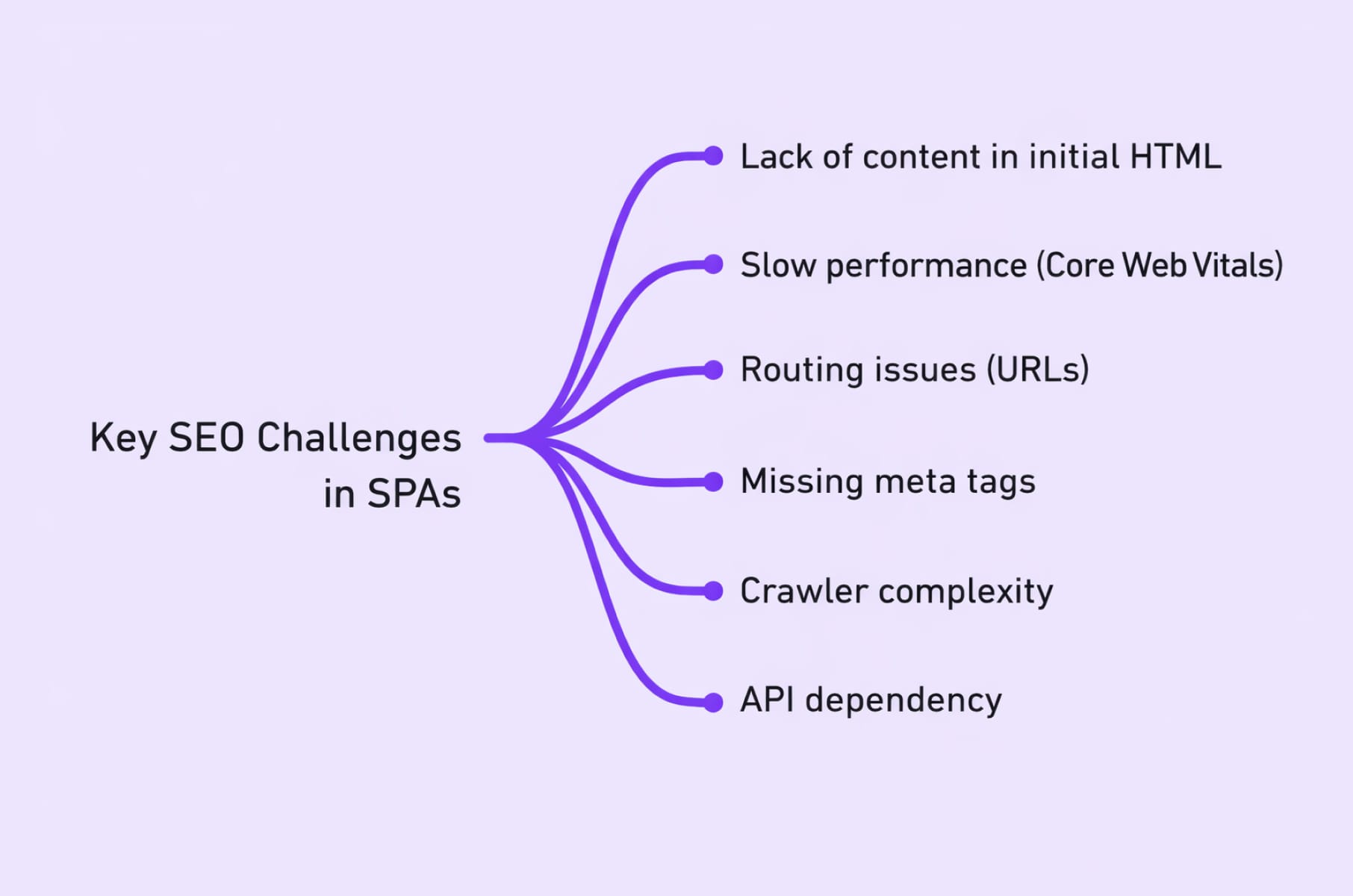
- Content not in initial HTML. A pure SPA often serves an almost empty HTML file. Search bots that don’t execute JavaScript would see no content. Even Google, which does render JS, might initially index a blank page if the rendering queue is slow. This is a core single page apps SEO problem – no crawlable text at first glance.
- Slow loading or poor performance. Large JS bundles can hurt Core Web Vitals. Google now uses these user experience signals for rankings. If your SPA takes 5 seconds to become interactive, users might bounce, and Google may downrank the page due to a poor experience.
- URL and routing issues. Each unique piece of content on your site should have its own URL for SEO. In SPAs, developers sometimes forget to implement clean URLs for different views. Such setups confound crawlers – if all your content is effectively on one URL, you can’t rank for multiple pages.
- Meta tags and Open Graph. With MPAs (multi-page sites), each page has its own <title>, meta description, and social preview tags in the HTML. SPAs must dynamically update these tags as the user navigates. If not configured, you might have an SPA where every section has the same title tag (e.g., “MyApp”), which hurts SEO. This is why SEO for SPAs often involves server-rendering or pre-rendering pages for social media crawlers as well.
- Crawler crawl budget and complexity. Google can index JS-heavy sites, but it does so in two waves (crawl HTML, then render JS). This means your SPA content might be indexed slightly later after the JS is processed. If your site has hundreds of pages loading via client-side navigation, Googlebot has to discover them via your scripts or an XML sitemap; it won’t automatically crawl what isn’t linked in plain HTML.
- Dependency on external scripts. Many SPAs rely on APIs to fetch data. If those API calls require authentication or are slow, the content might not load for the crawler.
SPA SEO best practices
Here’s how you can make SPAs SEO-friendly with our top must-do SEO solutions for single page apps in 2025:
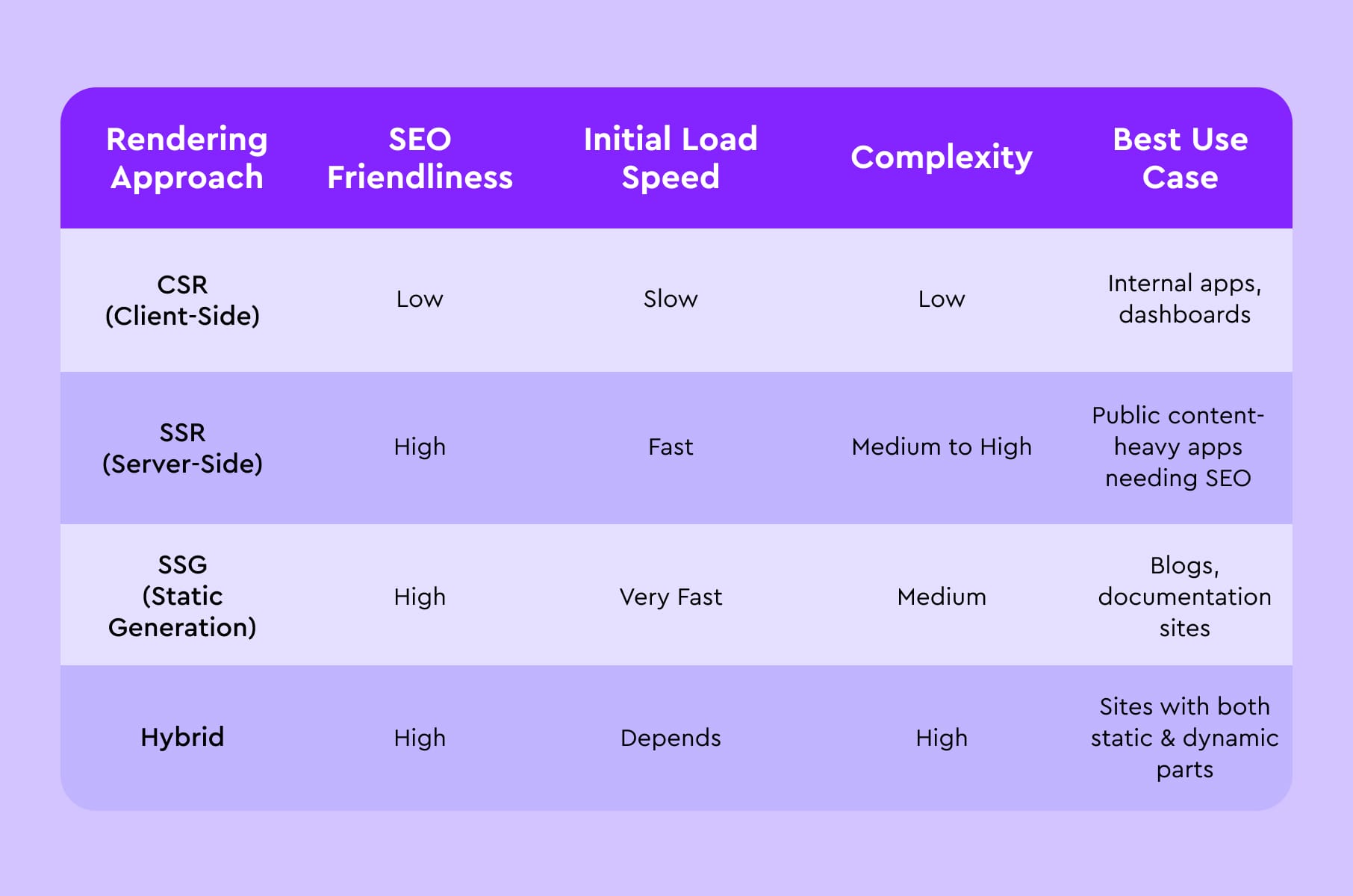
Use Server-Side Rendering (SSR) or Static Generation
This is the number one solution for SPA SEO. SSR means your server pre-renders the initial view of each page into HTML before sending it to the client. Search bots get fully-formed HTML with content, so there’s no ambiguity.
Modern frameworks have made this easier than ever by providing out-of-the-box SSR:
- For React apps, use Next.js or Remix (see our Create React App vs. Next.js - how they differ for an in-depth comparison);
- For Vue, use Nuxt 3;
- For Svelte, use SvelteKit.
Static site generation (SSG) is another approach – generate HTML files at build time for each route. Either way, the goal is to ensure the crawler sees meaningful HTML, not just an empty shell.
For a deeper comparison of static vs server rendering, see Next.js vs. Gatsby: which framework to use.
For most single page application SEO issues, SSR or SSG is the solution, which ensures your pages have pre-rendered content that crawlers can read.
Ensure unique, crawlable URLs
Every distinct piece of content or page in your SPA should have its own route (URL path) that can be accessed directly.
For example, in a documentation SPA, /docs/getting-started should load that content if accessed directly, not just redirect to a homepage.
Configure your routing such that server requests to those URLs either serve prerendered HTML (with SSR) or at least serve the SPA app with correct metadata.
Also, provide an XML sitemap listing all your important routes so crawlers know where to look. This helps with SEO for single page applications by guiding search engines.
Handle <title> and meta tags for each page
Use libraries or framework features to set the page title, meta description, canonical link, and Open Graph/Twitter card tags dynamically on route change.
This way, when Google renders your page, it sees the relevant title and description for that “page” of the SPA. If you implement SSR, these tags will even be in the initial HTML.
Unique meta tags improve your SEO (better keyword relevance and click-through rates) and are crucial for social sharing.
Remember, if someone shares your SPA link on LinkedIn or Facebook, those services won’t run your JS: you need proper meta tags in the static HTML for a nice preview. That’s another reason SSR or pre-render is important – it can output those meta tags for each route.
Optimize for speed and Core Web Vitals
Performance optimization is SEO single page app 101 in 2025. Google’s algorithm heavily factors in page experience. To optimize your SPA’s speed:
- Code-split and lazy load. Only load the JavaScript needed for the initial view first, then lazy-load other chunks when needed. Most SPA frameworks support code splitting. This reduces the bundle size users (and crawlers) must load upfront.
- CDN and cache. Serve your static assets (JS, CSS, images) from a fast CDN. Utilize HTTP caching so repeat visits (or crawler hits) aren’t fetching everything again.
- Compress and minify. Gzip or Brotli compress your files; minify your HTML, JS, and CSS. Every byte counts on mobile connections.
- Optimize media. Large images can slow down pages. Use modern formats (WebP/AVIF), responsive sizing, and lazy loading for images not in the initial viewport. For example, Next.js has built-in image optimization that can improve your performance metrics.
- Prioritize core content. Make sure the most important content renders first. If you have an SPA that waits to load a bunch of ads or secondary widgets before showing text, that’s bad. Instead, load primary text/content immediately, show less critical stuff later. Google’s crawler times out eventually – faster content means more content indexed.
Use schema markup and structured data
This is general SEO advice, but adding structured data (JSON-LD or microdata) to your SPA’s content can help search engines understand it better.
As one SEO pro on Reddit put it, “What matters is directing search engines to your semantic HTML. Include Microdata in the HTML… rendering what your HTML is expected to convey.”
Essentially, semantics and structured data can enhance your SPA’s SEO.
Provide an HTML sitemap or index page
If your SPA is small, consider creating an HTML sitemap page that lists all the key links. Or at least ensure your homepage links to your major sections (so that even a non-JS crawler can find them).
It’s not a substitute for full indexability, but it guarantees the discovery of sections.
Avoid blocking resources
Make sure your robots.txt doesn’t disallow the JS or API endpoints needed to render content. Googlebot needs to fetch your JS files to render the SPA. Don’t inadvertently block them.
Consider hybrid approaches
Depending on your site, you might not need every page to be a SPA. A common approach is to use SSR for public, search-facing pages (for SEO benefit), and use SPA mode for the app’s internal screens.
For instance, marketing pages could be done with Next.js static generation, while the logged-in app is a CRA or similar. This way, the public content is fully crawlable and fast, and your actual application can still be a rich SPA where SEO doesn’t matter.
This hybrid strategy is employed by many SaaS companies: the website is Next.js (or even WordPress for simplicity) and the app is a separate single-page bundle behind login.
Think about what parts of your site truly need to be SPAs.
If implementing these feels overwhelming, you can lean on experts. In fact, choosing a custom front-end (versus a template-based site) gives you the flexibility to implement all these optimizations. And if you need extra hands, the benefits of outsourcing frontend development are worth considering to get expert help.
Is SSR really necessary for SEO?
This is a frequent question in the SPA discourse: Do I really need server-side rendering for Google to index my site?
No, SSR is not 100% “mandatory” for Google – but it is necessary for the best SEO results and to avoid edge-case problems. Even Google’s official guidance now recommends SSR/SSG over tricks like dynamic rendering.
In our view, if you’re launching a public-facing site in 2025 and care about SEO, not using SSR is an unnecessary gamble. The effort to implement SSR is usually worth the payoff in reliable indexing and faster page loads.
It’s one of those “don’t bring a knife to a gunfight” situations – technically, you can try without SSR, but if your competitors are using SSR and delivering faster content, you’re at a disadvantage.
What are the 4 types of SEO?
SEO isn’t just one thing. Generally, we break it down into four types of SEO. Here’s a quick illustration:
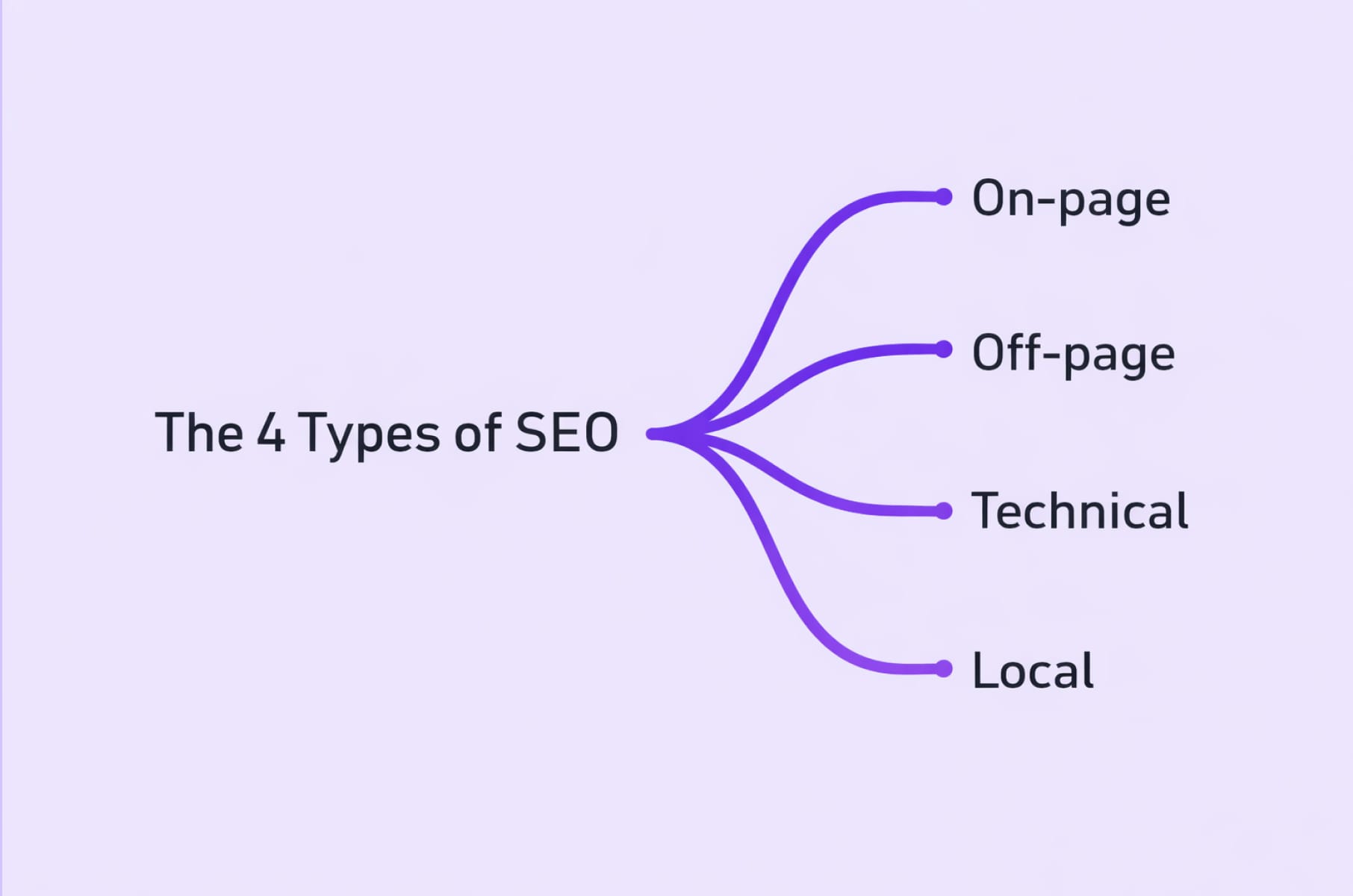
Basically, on-page SEO refers to optimizing the content on your website pages. It includes keyword research and usage in your copy, good titles and meta descriptions, header tags (H1, H2, etc.), image alt, etc. Off-page SEO is all your backlinks.
Then, technical SEO covers the site’s infrastructure and how easily search engine crawlers can access and index your content, while local SEO involves optimizing for location-based queries (“near me” searches), managing your Google Business Profile listing, local citations (directories), and garnering customer reviews.
For your single page application project, you’ll mainly focus on technical and on-page SEO. Off-page SEO is handled via marketing efforts (just make sure your content is worth linking to!). Local SEO only matters if applicable to your business model.
Internal reads from Merge
Our deep dive into modern web architectures. Explains when to use an SPA vs a traditional MPA, how “islands” architecture works, and debunks the myth that SPAs are universally bad for SEO.
Comparison of a pure client-side React app (CRA) vs Next.js (React with SSR). Useful to understand the practical benefits of SSR (Next.js) for SEO and performance, versus a classic SPA setup.
An overview of the latest React improvements (React 19, Server Components, etc.). There’s a section on SEO and performance where we discuss how modern React can deliver content faster to search engines. Good background on how SPA technology is evolving.
We compare three popular SPA frameworks and their pros/cons. Includes notes on performance and how each can meet Core Web Vitals with the right practices. If you’re choosing a framework for your next project, this gives a balanced view.
Both are React-based frameworks that help deliver SEO-friendly sites. This article breaks down their differences (SSR vs SSG, etc.), which is insightful if you’re weighing static generation vs server rendering.
A piece on the benefits of custom front-end development (as opposed to templated solutions). Relevant to SEO because a custom build gives you more control to implement optimizations like SSR, performance tuning, etc., that generic platforms might not allow.
If ensuring your SPA is SEO-optimized sounds like too much work, this article discusses how outsourcing to specialized front-end teams (like Merge) can help. We cover how external experts bring knowledge of best practices (e.g., SSR, Core Web Vitals) to supercharge your project.
A look at a classic CMS vs a modern React framework from an SEO and performance standpoint. It highlights that while WordPress has SEO plugins, Next.js often wins on speed and technical SEO (thanks to SSR). Useful if you’re evaluating a traditional approach vs an SPA approach for a content-heavy site.
Quality assurance is part of SEO too (a broken SPA won’t rank!). This article goes through tools and practices for testing front-end applications. Ensuring your SPA works flawlessly across devices and browsers will indirectly benefit SEO by providing consistent user experiences.
Stay up to date with emerging front-end tech (including SEO-related trends). This piece covers what’s hot in front-end as of 2025, from new JS APIs (like the View Transitions API mentioned earlier) to evolving best practices. Keeping an eye on trends helps ensure your SPA stays ahead in performance and user experience, which ultimately aids SEO.
Wrap-up
In short, a successful SEO single page app strategy is basically serving content that search engines can crawl easily and doing it fast enough to keep users (and Google) happy.
When done right, single page apps SEO can even outperform some traditional sites, because you have full control over content delivery and performance. In fact, many e-commerce and content sites have embraced frameworks like Next.js specifically for SEO.
If implementing any of the tips we mentioned throughout the article feels overwhelming, you can lean on experts.
In fact, choosing a custom front-end (versus a template-based site) gives you the flexibility to implement all these optimizations. And if you need extra hands, the benefits of outsourcing frontend development are worth considering to get expert help.
At Merge, we’ve helped clients in Fintech, SaaS, and other industries build SPAs that load fast and rank well. Our front-end development services are meant for combining great UX with solid technical SEO.