0
Table of Contents
Is Single Page Application dead in 2026? SPAs vs MPAs vs Islands
Single Page Application has evolved. Into what? Read our article and find out.

As a founder, you have likely heard developers arguing about frameworks for years.
It used to be simple.
You had a website. Then we got the Single Page Application, and everything became an "app." Now, we have Server Components, Hydration, Resumability, and Islands.
It is confusing now. Let's fix that.
We work with these technologies every day at Merge. We help clients in Fintech and Web3 navigate these choices to build products that scale. This guide will break down exactly what is happening with Single Page Application development right now so you can make the right call for your business.
Is a Single Page Application dead in 2026? No, but the "classic" way of building them, where a massive JavaScript bundle loads before your user sees anything, is rapidly dying. The concept has evolved into hybrid architectures.
If you are building highly interactive web applications — SaaS dashboards, Fintech trading tools, admin panels, or social platforms — a Single Page Application is still the superior choice. SPAs are designed for app-like experiences where users stay logged in and interact heavily, not for traditional content websites.
What is a Single Page Application?
To understand where we are going, we have to look at the map of where we have been.
What is a Single Page Application definition? A Single Page Application (SPA) is a web application or website that interacts with the web browser by dynamically rewriting the current web page with new data from the web server, instead of the default method of the browser loading entire new pages. The goal is faster transitions that make the web application feel like a native app.
In the early days of the web, every time you clicked a link, the browser had to go to the server, fetch a completely new HTML file, and paint the screen from scratch. This is the Multi-Page Application (MPA) model.
Then came the Single Page Application architecture. Developers realized we could load the "shell" of the site once. When the user clicks a link, JavaScript intercepts that click. It talks to the server in the background, grabs only the raw data (usually JSON), and updates just the part of the screen that needs changing.
What is SPA in web development today?
It is the standard for products that feel like tools rather than documents. Gmail, Trello, and Figma are prime examples of Single Page Applications.
How did SPAs evolve?
For a while, developers used Single Page Application JavaScript frameworks for everything. We built simple blogs as SPAs. We built marketing sites as SPAs.
This caused problems like:
- Performance - loading a massive bundle of JavaScript just to read a blog post is inefficient.
- SEO - search engines initially struggled to read content that wasn’t in the initial HTML file.
In 2026, we have moved toward hybrid solutions. Tools like Next.js or Remix allow us to build Single Page Applications that render on the server first. You get the SEO benefits of an MPA with the snappy interactivity of an SPA.
If you are curious about how we pick the right tech stack for these hybrid apps, check our thoughts on React Native and cross-platform development.
SPAs vs MPAs vs Islands
Choosing the right architecture should always be about the specific problem you are solving.
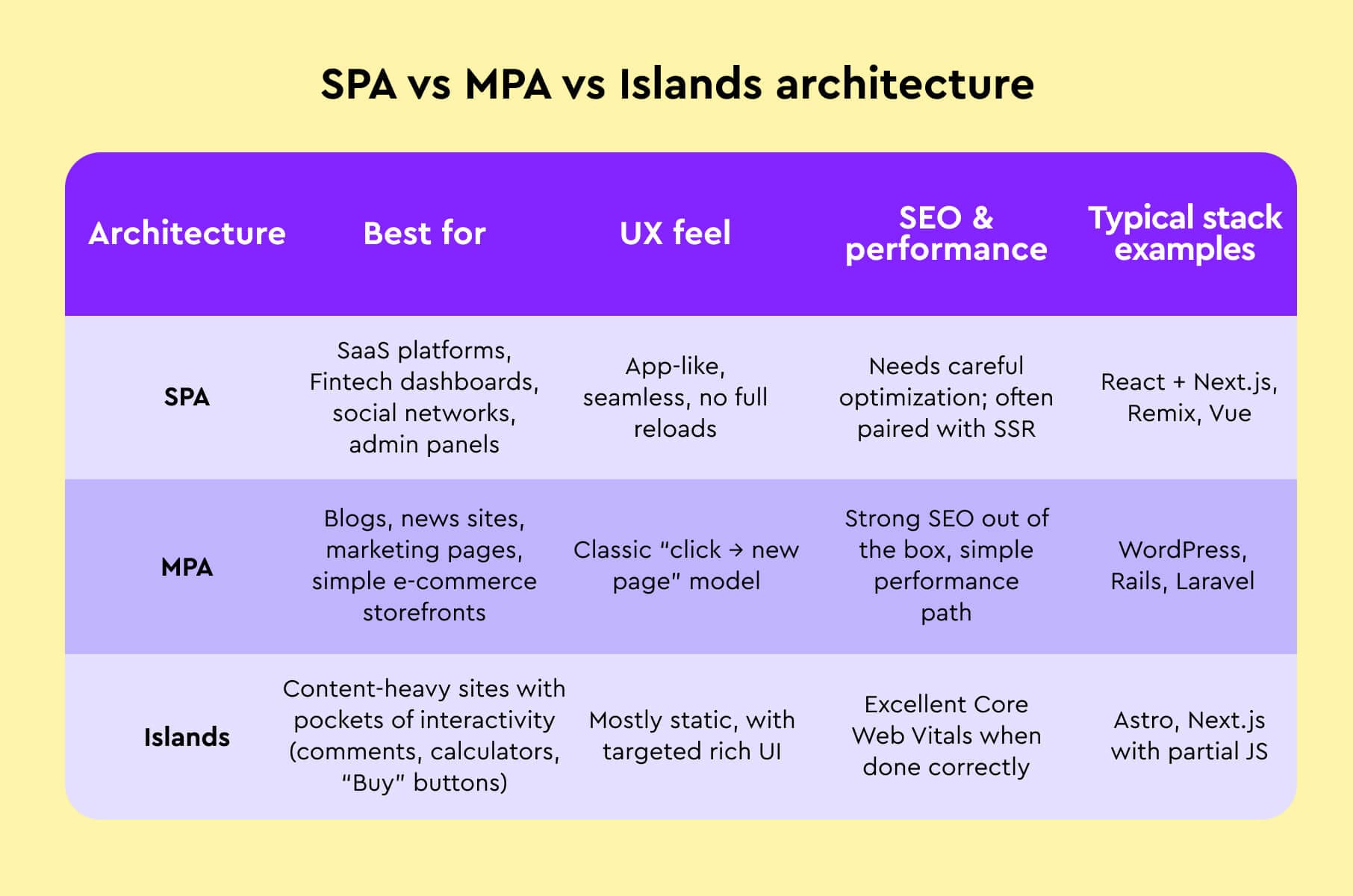
1. Single Page Applications (SPA)
Best for: SaaS platforms, Fintech dashboards, social networks, admin panels, and other interactive web applications where users perform tasks rather than consume static content.
What is SPA in web development practically? It is a continuous session. Once the user logs in, they never see a white screen refresh again.
We recently worked with a client building a crypto trading platform. They initially asked for a "simple website." We had to explain that a trading interface needs to update prices in real-time without reloading the page. If we used a traditional setup, the whole screen would flash every time Bitcoin moved a decimal point. That is a terrible experience.
We built a Single Page Application using React and Next.js. The result was a much better interface where charts updated smoothly while the navigation remained stable. This is how Single Page Application JavaScript frameworks work.
If you are looking to build a complex tool like this, check out our insights on the best frontend frameworks.
When does it make sense to optimize an SPA for SEO?
SPAs are inherently app-focused, but there are real use cases where SEO matters inside an SPA:
- Public product catalogs or directories — If your SaaS or marketplace has a public-facing catalog (e.g., a template marketplace, a searchable directory of listings), those pages should be crawlable. Hybrid rendering (SSR for public pages, CSR for logged-in app sections) solves this.
- Documentation and knowledge bases — If your app includes public help docs or a community wiki, rendering those pages server-side ensures Google indexes them.
- Public user profiles or portfolios — Platforms where users create public profiles (like a freelancer marketplace) benefit from SSR on those specific routes.
- Landing pages within the app domain — Keeping marketing pages on the same domain as your app can boost domain authority, and these should always be server-rendered.
The key takeaway: use hybrid rendering to serve SEO-critical public pages server-side, while keeping the logged-in app experience as a pure SPA.
2. Multi-Page Applications (MPA)
Best for: News sites, E-commerce storefronts (Amazon), Blogs.
MPAs are the "old school" web. Every time you click a link, the browser requests a fresh HTML file from the server.
Pros: Incredible SEO capability out of the box. The browser does very little work.
Cons: It feels "clunky" when navigating. You lose the application state between pages.
3. Islands Architecture
Best for: Content-heavy sites with small pockets of interactivity (like a "Buy" button or a comment section).
This is the trendy contender. Imagine a static HTML page (fast like an MPA) that has specific "islands" of interactivity. These islands are essentially mini Single Page Applications living inside a static page.
Frameworks like Astro have popularized this. It allows you to ship zero JavaScript for the text on your blog, but load a heavy React component just for the interactive calculator in the sidebar.
What's the status of SPA development in 2026?
Single Page Application development has matured. The days of shipping a 5MB JavaScript file to a mobile phone are now over, because Google’s Core Web Vitals pretty much killed that practice.
For example, here's what React 19 changed in front-end.
In 2026, we are also seeing:
Server-Side Rendering (SSR) as the default
Frameworks like Next.js and Remix now ensure the first paint is fast by rendering pages on the server at request time. This means the user sees content immediately, even before JavaScript fully loads. SSR is critical for SPAs that need to rank in search engines or serve first-time visitors quickly. It also eliminates the "blank white screen" problem that plagued early SPAs.
Static Site Generation (SSG) for predictable content
SSG pre-renders pages at build time, producing plain HTML files that can be served from a CDN with near-zero latency. This is ideal for pages that don't change often — product documentation, marketing pages, blog posts, or public catalogs. In hybrid SPA architectures, teams often use SSG for public-facing content and CSR for the logged-in application, getting the best of both worlds.
If you are curious about the tech stack we recommend, we wrote about it here: Comparing popular tech stacks for SaaS MVP development.
You can also check out the latest trends in front-end development.
The SEO question: Are SPAs bad for SEO?
This is the most common fear we hear. "I want a Single Page Application, but won't Google hate it?"
Are SPAs bad for SEO?
Not anymore. But you have to build them correctly.
Years ago, Google crawlers struggled to execute JavaScript. If your content was hidden behind a loading spinner, Google saw nothing. Today, Google is very good at rendering Single Page Application JavaScript.
However, there is a catch. "Hydration" takes time. If your SPA Single Page Application takes 5 seconds to become interactive, Google will penalize you for poor user experience (specifically, Interaction to Next Paint, or INP).
To fix this, we use Server-Side Rendering (SSR). This serves the content immediately to the bot.
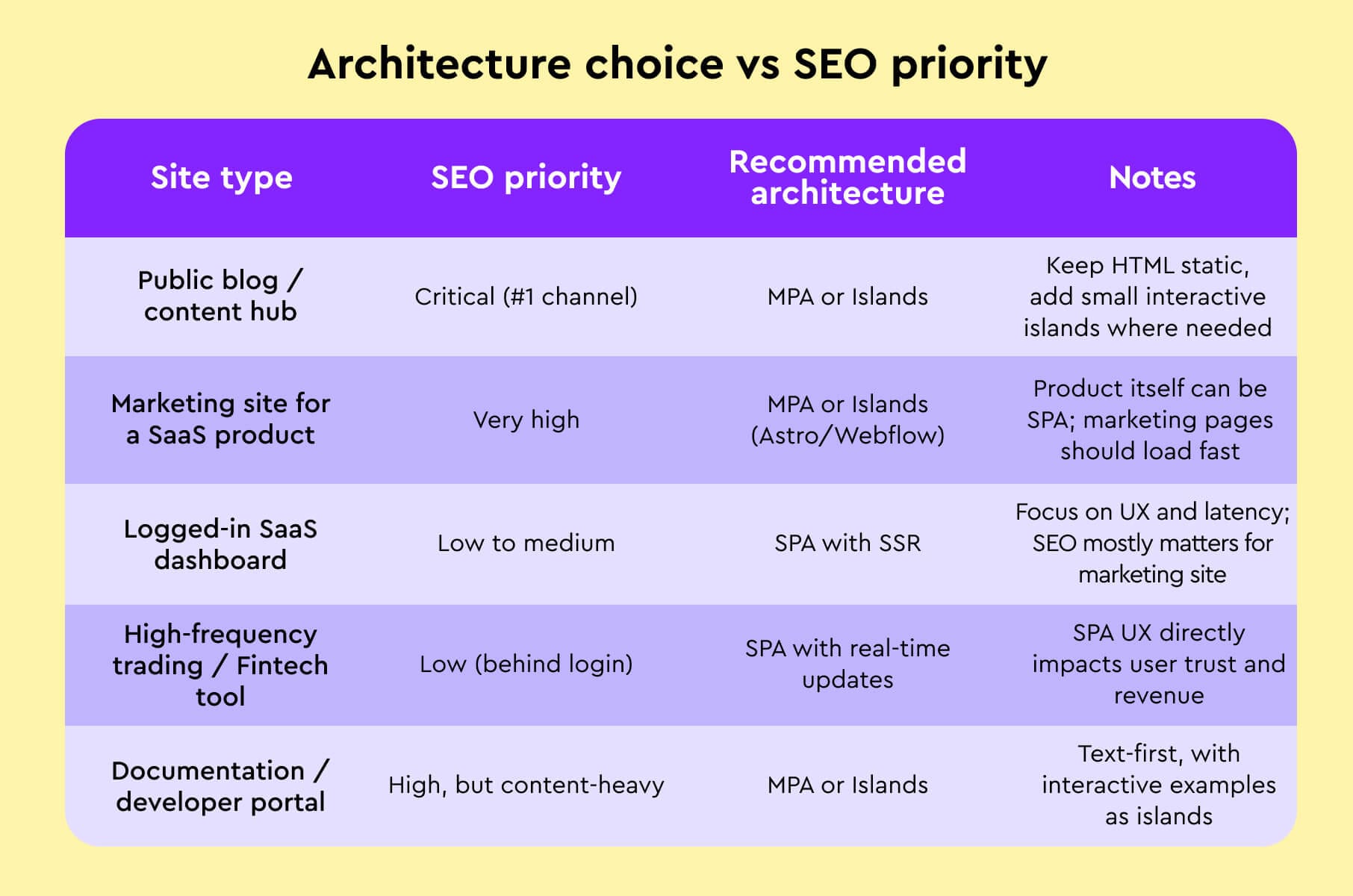
Tip: If your business relies 100% on organic search traffic (like a blog or a recipe site), do not build a pure SPA. Use an MPA or Islands architecture. If you are building a web application behind a login, SEO of the app itself does not matter — the marketing site does. For hybrid cases (apps with public-facing catalogs or profiles), use SSR on those specific routes.
Is front end dead in 2026?
You might have seen the viral tweets. "AI writes code now. Frontend is dead."
Really, is front end dead in 2026?
Absolutely not. Coding boilerplate is dead. Architecture is more alive than ever.
AI can write a function to fetch data. AI cannot architect a secure, compliant Single Page Application for a Fintech product that handles millions in transactions. AI cannot understand the nuance of user flow in a complex dashboard.
Maintaining the most out of the day-to-day front-end development deliverables, the role of the front-end developer has shifted from "pixel pusher" to "product architect." We spend less time centering divs and more time optimizing Single Page architecture for performance and scale.
If anything, the demand for expert front-end developers is higher because the tools are more complex.
Is it worth being a front-end developer in 2026?
Yes. But you must move beyond basic HTML/CSS. You need to understand state management, server components, and how to optimize Single Page Applications for latency.
Is web design dying in 2026?
Similarly, people ask: Is web design dying in 2026?
Well... Generic design is probably dying. So are templates. Not web design, though.
If you look at the top SaaS products of 2026, they don't look like Bootstrap templates. They have custom micro-interactions, unique typography, and "scrollytelling" elements. These experiences require bespoke design and development.
How JavaScript is changing Single-Page App navigation?
A major update is the View Transitions API.
Previously, to make Single Page Web Applications feel smooth, we had to write complex animation logic. Now, the browser handles the transition between states natively. This allows us to morph a product card into a full-page product view seamlessly.
This is critical because it reduces the amount of Single Page Application JavaScript we need to ship. Less code means faster load times.
Comparison: Which is better MPA or SPA?
This is the decision matrix we use with our clients at Merge.
Choose a Single Page Application (SPA) if:
- You are building a digital product (SaaS, Dashboard, Inbox).
- Your users stay on the page for long periods.
- You need rich interactions (drag and drop, real-time charts).
- You want a "native app" feel in the browser.
- You need React Native Development later (easier to port).
Choose a Multi-Page Application (MPA) if:
- You are building a blog, news site, or public marketing site.
- SEO is your #1, #2, and #3 priority.
- The content is mostly static text and images.
- You have a limited budget (MPAs can be simpler to host).
Choose Islands Architecture if:
- You have a content site that needs pockets of high interactivity.
- Performance (Core Web Vitals) is critical for ad revenue.
Which is better, MPA or SPA?
Neither is universally better. Single Page Applications are better for dynamic, task-oriented user interfaces where interaction speed is paramount. MPAs are better for information-oriented websites where initial load speed and SEO crawlability are the priority.
Are Single-Page Applications bad?
We often hear stakeholders ask: Are single-page applications bad?
They are only "bad" when used for the wrong purpose.
Building a simple personal blog as a complex React Single Page Application is over-engineering. It is bad because it introduces unnecessary complexity and load time.
However, for a Fintech application, a non-SPA approach is "bad" because it creates friction. Imagine trying to day-trade stocks, but every time you buy, the page reloads. You would lose money.
At Merge, we specialize in high-stakes industries like Fintech. We know that for these use cases, the Single Page app meaning translates directly to "revenue stability."
If you need a team that understands these stakes, take a look at our Fintech design and development services.
Common questions on SPAs
We frequently see these questions appear on Reddit and forums.
1. What is SPA in web development regarding security?
SPAs are as secure as MPAs, provided you handle tokens correctly (HttpOnly cookies) and secure your API endpoints. The frontend is never secure on its own.
2. What are Single Page Applications using for data?
They usually consume JSON data from a REST or GraphQL API. This decouples the frontend from the backend, allowing your team to work faster.
3. Single Page app meaning vs. PWA (Progressive Web App)?
An SPA is the architecture. A PWA is a set of capabilities (offline mode, installable) added to an application. Most PWAs are built as Single Page Applications. Learn more about mobile approaches here: PWA vs Native Apps.
4. Is Single Page architecture expensive?
It can have a higher upfront cost than a WordPress site, but it lowers technical debt for scaling products. It separates concerns, making future updates easier.
Additional resources from Merge
- Should your startup go React Native now? A 2025 cost, speed & UX breakdown – How to decide if React Native fits your product when you’re already investing in React on the web.
- Comparing popular tech stacks for SaaS MVP development: which one fits your needs? – A founder-friendly overview of backend and frontend stacks for SaaS products.
- Progressive Web App benefits in 2025 – Where PWAs make more sense than native apps and how they compare on cost, UX, and reach.
- What is the best front end framework in 2025? (Expert breakdown) – Trade-offs and hiring realities across React, Vue, Svelte, and other major frameworks.
- What is React.js in 2025 and why React 19 changed front-end again – How Server Components, streaming, and selective hydration reshape SPA architecture.
- Fintech dashboard design, or how to make data look pretty – Concrete patterns for high-signal, low-noise dashboards in finance products.
- TokenPlace: seamless UX/UI and efficient trading design – Case study of a multi-exchange crypto trading terminal with real-time dashboards.
- RelayPay: crypto payments for businesses – How Merge redesigned a crypto payments platform for better onboarding and everyday usage.
The verdict
SPAs remain the right choice for interactive web applications — dashboards, tools, and platforms where users perform tasks.
For content-driven websites, MPAs and Islands have taken the lead.
The best teams in 2025 use hybrid architectures that combine the strengths of each approach based on what each page actually needs to do.
If you are unsure which Single Page Application architecture fits your vision, or if you need a team to execute the front-end with precision, we are here.
If you have a project in mind, let’s talk.