0
Table of Contents
Should your startup go React Native now? A 2025 cost, speed & UX breakdown
For 90% of startups in 2025, React Native is the correct business choice.

Short answer for founders – yes, most SaaS, fintech, marketplace, and Web3 startups can safely bet on React Native in 2025 if they want fast, multi-platform delivery and have already invested heavily in React on the web.
For 90% of startups in 2025, React Native is the correct business choice.
Unless you are building a high-fidelity 3D game engine or an app that relies almost exclusively on obscure hardware integration, the New Architecture introduced recently has effectively closed the performance gap with native Swift or Kotlin.
If you are asking what React Native is and why it matters now, the answer lies in the removal of the "Bridge." We will explain why that matters for your budget and user retention below.
This guide focuses on the business and technical realities of 2025. We are skipping the basic history lesson. Instead, we will look at the financial and UX impact of the latest updates.
Should your startup use React Native in 2025? Here’s how to make a decision
For founders and non-developers, here is how you quickly decide.
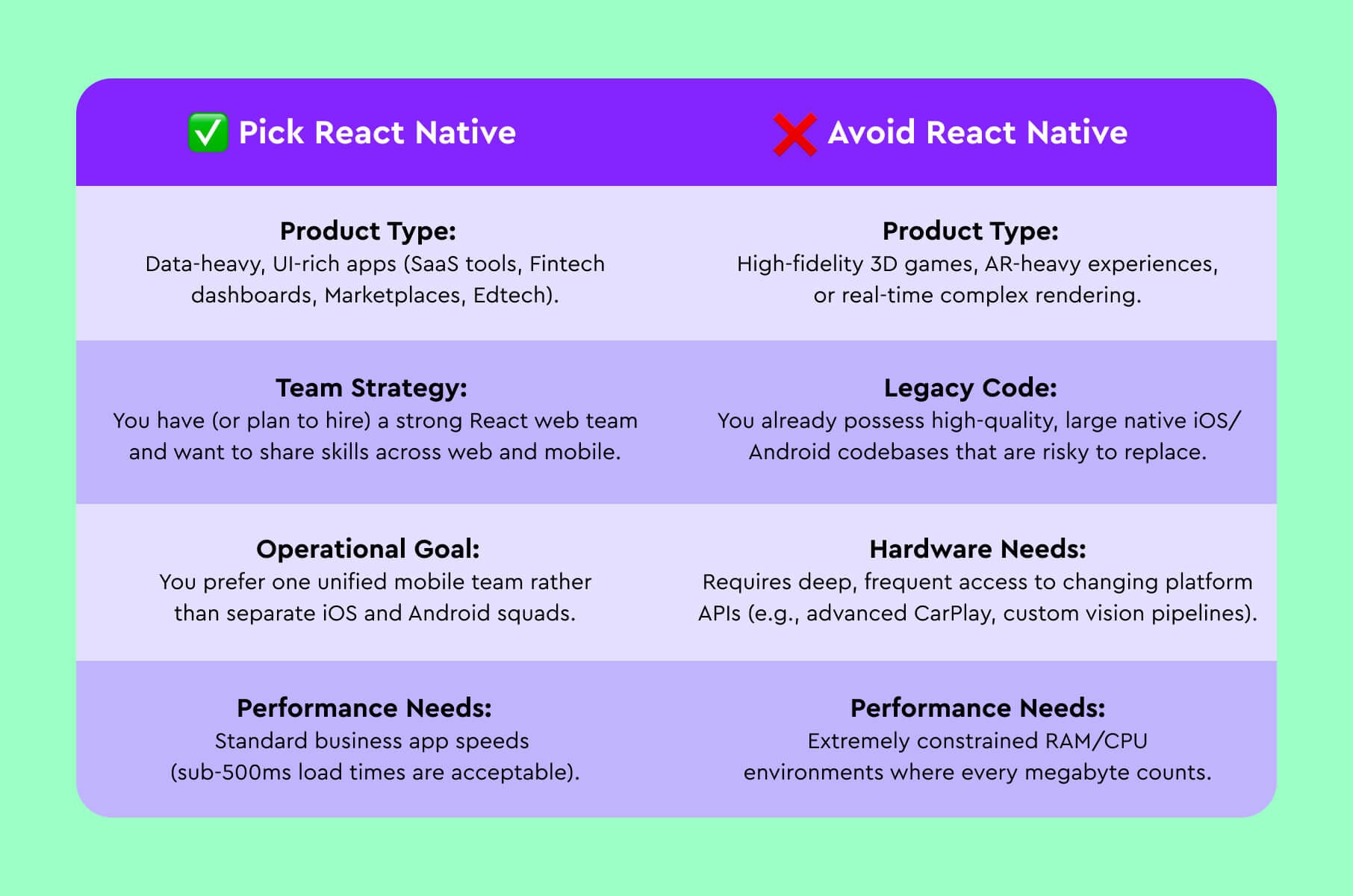
Pick React Native if your startup:
- Builds “data-heavy, UI-rich but not GPU-intense” products – think fintech dashboards, SaaS tools, marketplaces, internal tools, or edtech.
- Has or plans to hire a strong React web team and wants shared skills, patterns, and at least some shared code across web and mobile.
- Prefers one joined mobile team and codebase across iOS and Android instead of two platform-specific teams.
- Accepts that the first release may come faster, but you still need proper QA, performance work, and mobile-specific UX attention.
Avoid leading with React Native if your product:
- Is closer to a game, real-time 3D experience, AR-heavy app, or very custom camera/vision pipeline.
- Requires deep, frequent access to platform APIs that change often – for example, advanced CarPlay / Android Auto integrations or OS-level security work.
- Already has large, high-quality native iOS and Android codebases that would be risky and expensive to replace.
If you are in the grey area, build one thin vertical slice in React Native – onboarding and one core workflow – and measure startup time and interaction latency on mid-range devices, then decide.
Decision checklist: Is React Native right for you?
A quick guide for founders to determine if their product fits the 2025 React Native use case:
How startups used React Native before, and why that is now outdated
From about 2016 to 2022, the typical startup approach to React Native looked like this:
- Use it as a quick way to “wrap” existing REST APIs and ship an MVP mobile app.
- Rely on the old asynchronous JavaScript bridge, which sent messages between JavaScript and native code in batches. This design made animations, gestures, and complex lists feel fragile on lower-end devices.
- Pull in many third-party libraries that were not always maintained or aligned with Apple and Google’s latest SDK changes.
- Finally, embed React Native app modules inside larger native apps, which made build pipelines and ownership tricky.
This earlier generation of React Native development led to several pain points that founders still remember:
- Random layout glitches when screens got complex, due to older Yoga layout behaviors and the bridge overhead.
- Jank in heavy lists or charts when business logic, network calls, and animations all fought for the same JavaScript thread.
- Upgrades that felt risky because many libraries were not ready on day one.
At the same time, some companies quietly made React Native software development work at a serious scale – Facebook Ads Manager, early Instagram surfaces, some parts of Facebook itself, plus many others listed in the official showcase.
Those teams invested heavily in performance tooling, testing, and design systems. For a typical early-stage startup, that level of investment was unrealistic, which is why many founders walked away with “React Native is flaky” as a mental note.
What changed by 2025?
2024–2025 is the point where React Native became a more modern mobile runtime. The most important change for your decision is the New Architecture.
Key architectural changes that matter to a founder
You do not need the low-level details, but the outcomes are very relevant:
- Fabric renderer – a new C++ rendering layer that gives more predictable layouts, faster UI updates, and better alignment with React 18 features.
- JSI, TurboModules, and (in newer work) NitroModules – a new way for JavaScript to talk to native code without the chatty asynchronous bridge, which reduces overhead and tail latency.
- Hermes engine – a JavaScript engine optimized for mobile that is now the default, giving faster startup and lower memory footprint than older engines.
- React Native 0.76 – New Architecture and React 18 enabled by default, no experimental flags.
For you, this means a modern React Native application in 2025 can:
- Load the first screen noticeably faster than older versions on the same hardware.
- Keep scroll and animation smooth even when network calls and business logic are active, when implemented correctly.
- Use many of the same patterns your web React team already uses – concurrent rendering, familiar debugging tools, and performance profiling.
On top of this, Expo has matured into the default path for greenfield React Native application development – from over-the-air updates to stable build pipelines and increasingly complete support for the New Architecture.
This is why companies like Shopify, Coinbase, and Tesla publicly double down on React Native instead of walking away from it. Shopify reports sub-500 ms P75 screen loads in their main app. Coinbase rewrote their mobile apps to consolidate teams, and Tesla uses React Native for a large part of its complex control app.
React Native speed in 2025. Benchmarks and real-world performance
Independent benchmarks and vendor write-ups in 2024–2025 show:
- On typical CRUD and “feed” style apps, React Native with Hermes and the New Architecture usually reaches 50–55 FPS with acceptable startup times and memory usage.
- Flutter often wins raw FPS and frame stability, especially for animation-heavy UIs, although both are more than adequate for standard business apps.
- Shopify reports P75 screen loads under 500 ms in their large commerce app by combining React Native performance tooling, careful navigation design, and lazy loading.
For most startup use cases such as authenticated dashboards, account management, simple real-time feeds, etc., the bottleneck is not the React Native runtime, but:
- Backend latency and API design.
- How much data you fetch per screen.
- Whether developers block the JS thread with heavy logic instead of moving it to background threads or native modules.
Where React Native still struggles
You should be cautious with React Native mobile app developer work when your product:
- Needs very low-latency audio, video, or camera pipelines with custom codecs or ML – teams often hit native or Flutter for these.
- Relies on advanced platform-specific UI (for example, custom lock-screen components, watch apps, or very tight CarPlay integrations).
- Targets devices with extremely constrained RAM and CPU, where every megabyte and wake-up counts.
In such situations, even the improved React Native architecture cannot fully conceal the cross-platform abstraction cost, and you should budget for more native modules or even separate native apps.
Why React Native can reduce cost for the right startup
Three cost drivers typically favor React Native for early-stage teams:
- Shared talent pool – JavaScript and React remain the most widely used web technologies, so hiring or contracting a React Native developer is generally easier than finding strong mobile-only engineers in Swift and Kotlin.
- Consolidated mobile team – you avoid separate iOS and Android squads, which simplifies product management, release scheduling, and knowledge sharing. Coinbase explicitly cites this as a major reason for their migration.
- Shared patterns with web – even when code reuse is modest, your teams can share design systems, testing approaches, and performance practices already used in React web apps.
If your startup already invests in a custom frontend, a React-heavy stack on the web, and regular UX improvements, an aligned React Native development strategy often provides the best long-term ratio of speed to cost. For a deeper view on custom frontends at startup scale, see Merge’s perspective in Why custom frontend for startups works better in the long run.
Hidden costs
At the same time, several cost items do not disappear with Native React approaches:
- Platform-specific polishing – you still need iOS-specific and Android-specific QA, accessibility adjustments, and UX tailoring.
- Native modules – for payments, biometrics, media, and some analytics, you may rely on bridging to native SDKs. For fintech or health, those SDKs change often, which requires ongoing maintenance.
- Performance work – scrolling, gestures, and animations still need profiling and optimization. Your team must learn the mobile-specific tuning described in guides like How to optimize the performance of a React app, extended to mobile.
If you do not yet have strong internal frontend leadership, partnering with a specialist studio such as Merge for front-end development can mitigate some of these risks.
UX in 2025 – how “native” does a React Native app feel now?
From a user’s hand-on-glass perspective, a well-built React Native app today can feel as polished as a native one in most business domains thanks to:
- Yoga 3.0 – more predictable layout, better parity with web flexbox behavior, and fewer layout bugs when porting complex designs.
- Fabric renderer – UI work scheduling that aligns better with React 18 concurrent features, which helps avoid sudden frame drops in complex screens.
- Modern gesture and animation libraries – Reanimated, Gesture Handler, and performance-focused navigation stacks tuned for the New Architecture.
- Tooling from companies like Shopify – libraries for measuring and improving interaction performance in production.
UX risks specific to React Native, from a founder’s view
The main UX risks for a React Native mobile app developer team are:
- Under-investing in platform-specific patterns – e.g. forcing Android users into iOS-style tab patterns or ignoring system gestures.
- Letting the JS thread do everything – long-running logic on the JS thread blocks animation, so poorly structured code leads to “random” jank.
- Lagging behind OS features – when Apple or Google ship new UX features, the community often needs time to update wrappers and modules.
You can control these risks through design systems, component libraries, and Storybook workflows. Merge, for example, often sets up component libraries with React Storybook development so designers and engineers can validate states, accessibility, and performance before those components hit real devices.
If you want deeper reading on how frontend decisions affect UX quality, the following resources from Merge’s blog are helpful references:
- Building efficient user interfaces with React
- What are the day-to-day front-end development deliverables
Additional resources from Merge’s blog for your React Native decisions
If you want to go further on related choices, these internal articles connect directly to a React Native strategy:
- Mobile app development using React Native: Pros and Cons – earlier but still useful perspective on trade-offs.
- Building Progressive Web Applications with React – how PWAs compare as an alternative or complement to mobile apps.
- What is a front-end framework? – clear explanation that helps when people ask again whether React Native is a framework.
- Latest trends in front-end development – puts cross-platform mobile in a broader context.
- Comparing front-end frameworks for startups in 2025: Svelte vs React vs Vue – helps you think about React on web plus mobile with React Native as a full-stack decision.
Key takeaways
Three concrete actions you can take this week:
- Write down performance and UX budgets for your mobile app in numbers, then ask your team whether React Native can meet them with the New Architecture.
- Commission a narrow React Native application spike (onboarding + one vital workflow) and measure startup time and interaction latency on real mid-range devices.
- If you lack in-house frontend leadership, speak with a specialist studio such as Merge about a focused discovery engagement to pick between React Native app development, PWAs, or fully native builds – before you commit the whole budget.
Used with this kind of structured thinking, React Native is no longer a hype-driven choice. It becomes one of several clear, well-understood options in your front-end strategy, especially when your startup is already in the React ecosystem.
If you need a partner who has navigated these waters for Fintech, Edtech, and Web3 clients, our front-end development team is ready to help you build.