0
Table of Contents
Before you hire a B2B web design agency, answer these 9 questions
Because a brief that is too lazy will get you a politely formatted guesswork, but guesswork nonetheless.
The brief you send a B2B web design agency sets your project's trajectory more than almost anything the agency does afterward.
A specific, honest brief gets you proposals you can actually compare and a productive kickoff. A brief that is thin and too lazy gets a politely formatted guesswork, but guesswork nonetheless, and usually a re-scoping conversation soon after.
This guide is for founders, product leaders, and marketing owners about to hire a B2B web design agencyWhat for the first or second time. Rather than listing every nice-to-have in a website brief, we'll walk through nine questions worth answering for yourself before any agency call, so the people on the other side can scope quickly and price honestly, without the mid-project chaos that turns a six-week build into a six-month one.
Our team at Merge has been doing B2B web design services for SaaS, fintech, AI, and martech startups for a while now, and these nine questions are the ones we ask in every kickoff anyway. Founders who arrive with the answers ready tend to get cleaner proposals and faster timelines, so consider this a head start on that conversation.
Also, a side note - plenty of articles we saw during our research already cover "what to ask the agency", so we won't write another. This guide is the inverse: the questions your B2B website design agency wishes you had already answered.
Question 1: What outcome should this site actually drive?
The first question almost nobody answers properly in their initial brief is the most important one: What does success look like a quarter after launch?
Briefs usually open with a deliverable: "We need a redesign." An outcome - "We need our enterprise pipeline to come from the website instead of outbound" - is what an agency can actually scope and price, and it gives every later page decision a tie-breaker.
Pick one primary outcome and at most two secondary ones. Common B2B options include:
- Inbound demo requests from a specific ICP segment.
- Self-serve sign-ups for a free trial or PLG flow.
- Enterprise pipeline from named accounts.
- Investor and recruiting credibility for a Series A round.
- Better organic ranking for a category-defining keyword cluster.
These pull a website in very different directions. A site optimized for self-serve sign-ups looks nothing like one optimized for enterprise procurement. And Forrester's research shows that more than half of large B2B transactions over $1 million will go through digital self-serve channels, so this choice now shapes the entire information architecture, not just the CTA copy. Pick the outcome that funds the project, not the one that's easiest to describe.
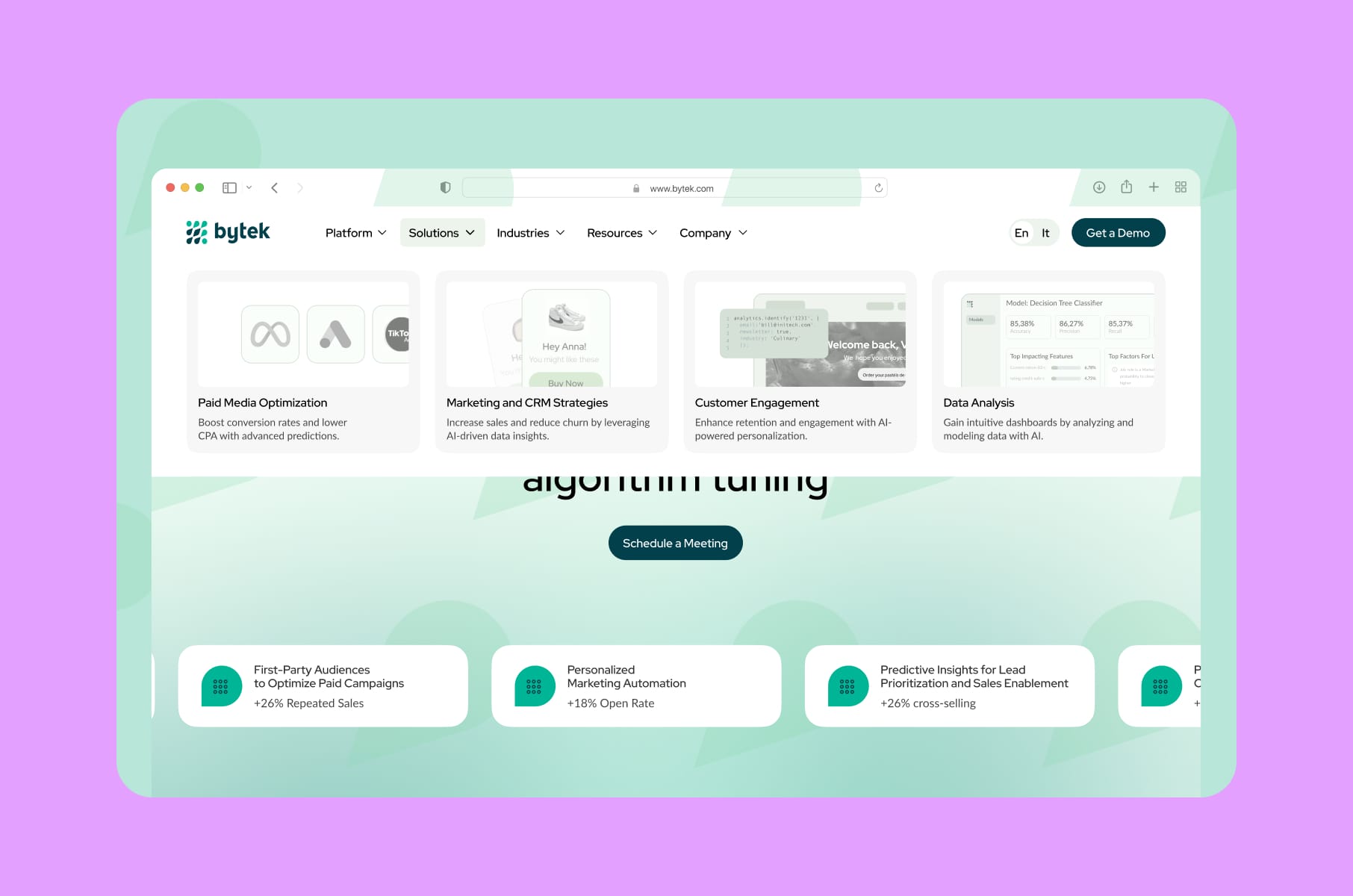
When Bytek came to us, the outcome was clear from the start: shift the website from an agency-image site to a product-focused brand and generate more qualified leads. That clarity made the whole website redesign service shorter, because every page decision had a single tie-breaker. (Bytek case study)
Question 2: Who exactly is the buyer, and which version of them are you designing for?
Most B2B sites read like they were written for "decision-makers." Mind you, "decision-makers" is not a persona. It is the empty space where a persona used to live.
Before any agency call, write down your ICP at the level of detail a copywriter could actually use. Job title, company size, industry, current tool they're replacing, and the moment they realize they need a new one. If you have ten paying customers, your ICP is hiding in the three or four who closed fastest and still use the product. Look at those.
Then choose the version of the buyer the site is meant for. Almost every B2B website serves at least three readers: the user who will use the tool day-to-day, the economic buyer who signs the contract, and the technical evaluator who scrutinizes the architecture. You cannot rank them as equals on the homepage, so pick one.
This is also where buyer-side research has changed. According to Forrester, self-directed buying interactions now outnumber human interactions roughly 15 to 12 across the buying cycle, and 89% of B2B buyers use generative AI for self-guided research before they ever take a sales call. So your homepage now has to teach, not pitch.
A useful side-effect of this question is that the brief gets shorter. Once you can name the primary persona, the B2B website design company you hire can pre-write the headline, choose the imagery direction, and pick the right testimonials before the kickoff call even ends.
Question 3: What does your analytics actually say today?
Before you redesign a single page, pull 30 days of clean Google Analytics data and write down the numbers. This step takes a founder maybe two hours. It saves them six months of "did the redesign actually work?" arguments later.
You need a baseline for:
- Sessions and unique users by source (organic, paid, referral, direct).
- Top 10 landing pages by traffic and the conversion rate on each.
- Bounce rate and average session duration.
- Goal completions: form fills, demo requests, sign-ups.
- The conversion rate from your top organic landing pages.
This is non-negotiable. A website launch is a data event, not a completion event, and if you don't have a "before" snapshot, you cannot prove the redesign worked even if it did. Worse, you can't catch silent regressions. We've seen founders lose roughly half of their organic traffic in days after a redesign because nobody set up 301 redirects from old URLs, and there was no baseline to spot the drop fast.
If you're going to put real money into a B2B web design agency, you also want to invest two hours into baselining the numbers. The agency should ask for this on the first call. If they don't, that's a small red flag.
While you're at it, also map your top organic pages by their inbound backlinks. Pages with a lot of links pointing at them are the ones that absolutely have to keep their URL (or get a clean 301), or you will pay for the redesign twice, once in fees and once in lost traffic.
Question 4: What success metrics will you measure 90 days after launch?
Okay, question 3 was about where you are. Question 4 is going to reveal where you're going. Here, our advice would be to pick three to five metrics that the new site will be judged on. They should ladder up to revenue. A useful B2B set looks like this:
Metric | Healthy range for B2B SaaS | Why it matters |
MQLs per month (organic + direct) | Trending up within 90 days | Paid traffic is a confounder, so judge the site on unpaid sources |
MQL-to-SQL conversion rate | Well below that means the site sells the wrong story to the wrong reader | |
Visitor-to-lead conversion rate | 1.1-1.5% average, 8-15% top decile | Moving from ~1.5% to ~3% is a realistic redesign goal, the top decile isn't |
Pipeline contribution from web-sourced leads | Defined with your finance team | The one number your CFO will actually ask about |
Core Web Vitals | All green, load near 1 second | Sites loading in 1 second convert at 3x the rate of those loading in 5. Performance is not separate from conversion. It is the conversion |
Write these down. Share them with the agency at the first kickoff. A serious B2B web design firm will scope the work backwards from these numbers, not forwards from a feature list. If your B2B website agency can't connect a design decision to one of these metrics, it's probably decoration.
Question 5: Which references would make you say "yes, this is the energy"?
Founders are weirdly shy about this one. They want the agency to "have ideas," so they hold back examples in case it limits creativity. Nope. The opposite is true. Sharing reference sites makes the work faster and the proposal more accurate.
You want three reference categories, and you want maybe three to five sites in each.
- Sites you love and want to feel like. Tonal references. Doesn't have to be a competitor.
- Sites in your category whose structure makes sense to you. Useful for sitemap and IA discussions.
- Sites you actively hate. This is the godsend category. Negative references prevent more arguments than positive ones do.
You can find some solid examples in our roundup of the best SaaS websites of 2026 and a complementary teardown of the five mistakes we keep seeing on landing pages. Both are useful for jolting your taste loose.
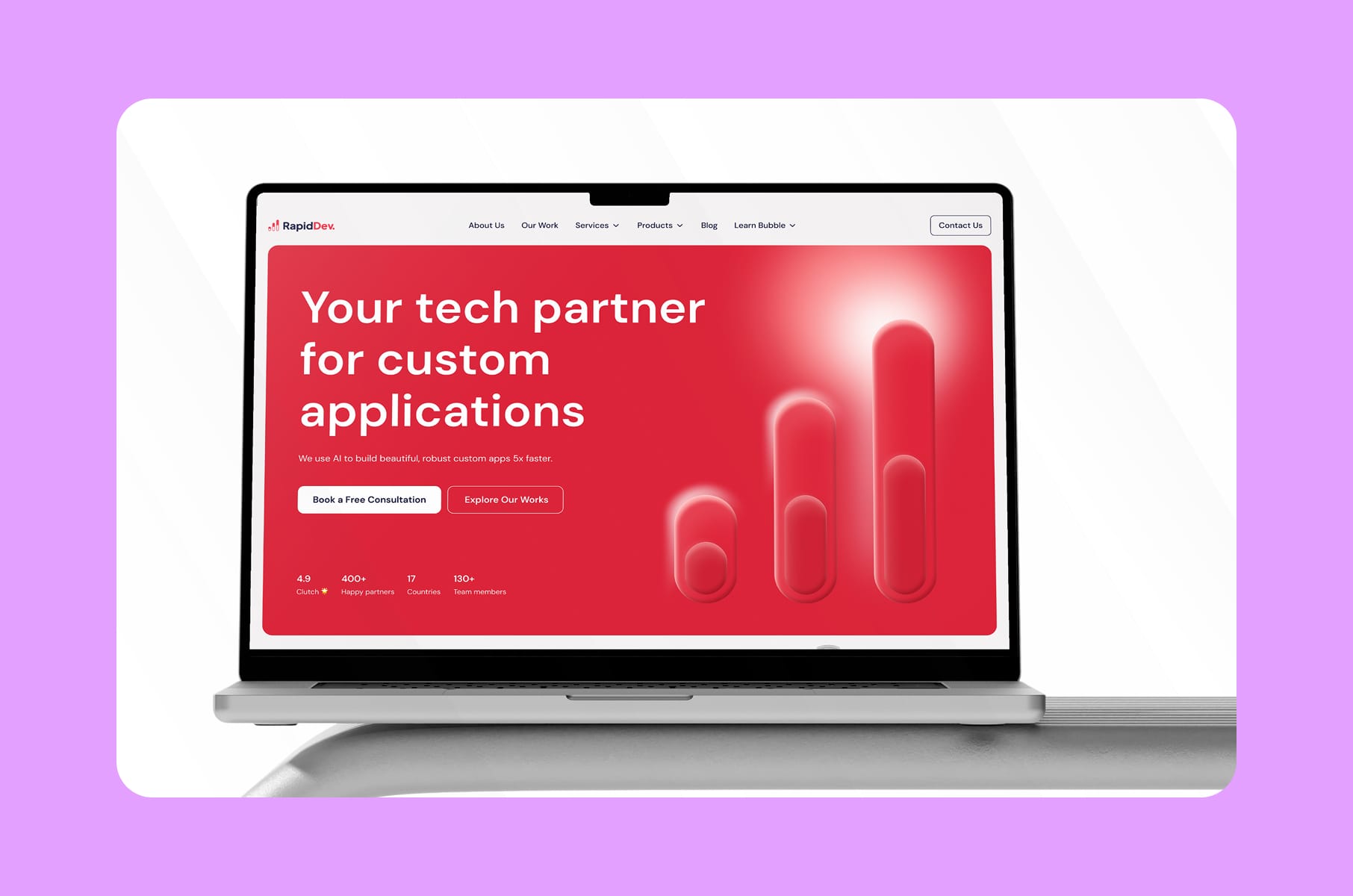
For RapidDev, the framing the client gave us was rather direct: "everyone in our industry has cookie-cutter websites, and we want to stop looking like them." That single line of reference (or rather, anti-reference) shaped the entire brand refresh and Webflow build. (RapidDev case study) When references are this clear, a B2B web agency can compress two weeks of taste-finding into two days.
One more thing here. When you share references, also write one sentence about why you picked each one. "I love this hero because it shows the product UI," tells the agency way more than "I love this hero."
Question 6: What are your tech and CMS constraints, in writing?
This is where a lot of B2B web design agencies lose two weeks they didn't budget for.
Before the proposal phase, you need clarity on:
- The CMS or tech stack you're staying on (or leaving). Webflow, HubSpot, WordPress, Next.js, Framer, custom. Each has very different cost and timeline implications. The 2026 trend, according to Pravin Kumar's research on B2B teams, is keeping HubSpot for CRM and running the site on Webflow, connected through forms. That setup is now common for a reason.
- Who controls the domain, DNS, and analytics access. If it's a contractor from three years ago and nobody knows the password, the agency needs to know that on day one.
- Mandatory integrations. HubSpot forms, Salesforce, Segment, Intercom, Calendly, Mixpanel, and your auth provider for gated content. Each integration adds scope.
- SEO non-negotiables. Pages that absolutely cannot lose their URL. Old blog posts ranking for high-intent terms. Resource pages with inbound links.
- Performance and accessibility floors. "Site has to pass Core Web Vitals in the green" is a constraint with cost. "Site has to be WCAG 2.1 AA compliant" is another. Both are reasonable. Just say so up front.
When Jurny came to us, the constraint was that the new site had to live on HubSpot CMS, because their marketing team was already deep in HubSpot for CRM and campaign automation. That shaped every part of the engagement, from page-limit planning to how custom modules got built. We delivered a fully custom marketing site inside HubSpot, with motion design and a restructured mega menu, while keeping the marketing automation benefits the team already relied on. (Jurny case study)
If you can put these constraints in a one-page doc before the first call, you'll filter out the agencies that only work in one platform regardless of fit, and you'll get sharper proposals from the rest.
Question 7: How much content will actually be ready on launch day?
Most B2B website projects slip because of content. Walk through your sitemap and, for each page, mark one of three statuses:
Status | What it means | What to do before kickoff |
Ready | Copy approved, images exist, customer logos cleared, case studies have quotes | Lock it and move on |
In progress | Someone is actively writing it | Attach a name and a realistic date |
Doesn't exist yet | Be honest - this is usually 40% of the sitemap | Decide who writes it and what that costs |
Then ask yourself: who is writing the missing copy? You're an in-house marketer? The agency, billed separately? A freelance writer you haven't hired yet? Each answer changes the timeline and the budget.
This is also where you should be brutally honest about case studies. Most B2B founders show up wanting six. They have one done, two half-written, and three customers who said yes but never sent the quote. Plan for what you actually have, not what you wish you had. A solid B2B SaaS design agency will help here, but they're not magicians. We can design around content gaps. We can't manufacture testimonials.
For Restream, the content question never went away, since the project was ongoing website support rather than a one-shot redesign. We worked from a shared backlog in Linear with context in Notion, which let the team ship a new pricing page, refresh About and homepage sections, and launch a "Restream for Business" page without ever blocking on content gaps for too long. (Restream case study)
Question 8: Who decides, how fast, and how do you handle change requests?
Now we're at the question that ruins more B2B web design projects than any other: governance.
You need clear answers to a few small things:
- Who is the single decision-maker on the client side? Not the committee. The one person whose "yes" actually means yes.
- What is the maximum review turnaround time? Three business days is healthy. Three weeks might ruin projects.
- How will you handle change requests once design is in flight? A new section idea that comes up in week four is fine. A new section idea that arrives without a process for re-scoping is how budgets explode.
This is where this prioritization method is handy. Sort every feature into Must, Should, Could, Won't, then defend that list when stakeholders try to sneak things in. Without that list, scope creep stops being a risk and becomes a line item on your invoice. Bop Design calls this "defining what's included and what's not," and that's basically the whole game.
Also, on your side, name an internal owner for the project from day one. The agency's project manager cannot also run yours. If your project owner is the CEO with two minutes a day, the project is going to feel slower than it actually is. That's a planning problem.
Question 9: What's your real budget range and launch window?
Last but not least: the two numbers a B2B website design company needs to actually quote you accurately. They feel like the awkward ones to share, but they aren't. Withholding them is what triggers the dreaded RFP-tourism cycle, where you collect proposals you can't compare.
Some baselines for a B2B web design company quote (from public 2026 pricing data):
Site tier | Typical scope | 2026 price range |
Small B2B site | 5-7 pages, basic CMS, minimal animation | $5k-$15k |
Growth-stage B2B site | 10-20 pages, custom design, integrations, motion, a real CMS | $15k-$50k |
Enterprise / category leader | Custom dev, localization, structured proof, governed analytics events, complex IA | $50k-$100k+ |
If your budget is $7k and you want what Stripe has, an honest B2B web design firm will tell you so on the first call, and that's a gift. If you don't share a range at all, you get back proposals scoped at wildly different levels, none of which match what you can actually spend, and you waste two weeks comparing apples to oranges.
The launch window matters just as much. "We want to ship in six weeks" produces a fundamentally different proposal than "we want to ship by Q4." Most quality B2B web design agencies will simply pass on aggressive timelines rather than overcommit, because the agencies that take six-week timelines for serious sites are usually the ones who can't deliver the quality you want.
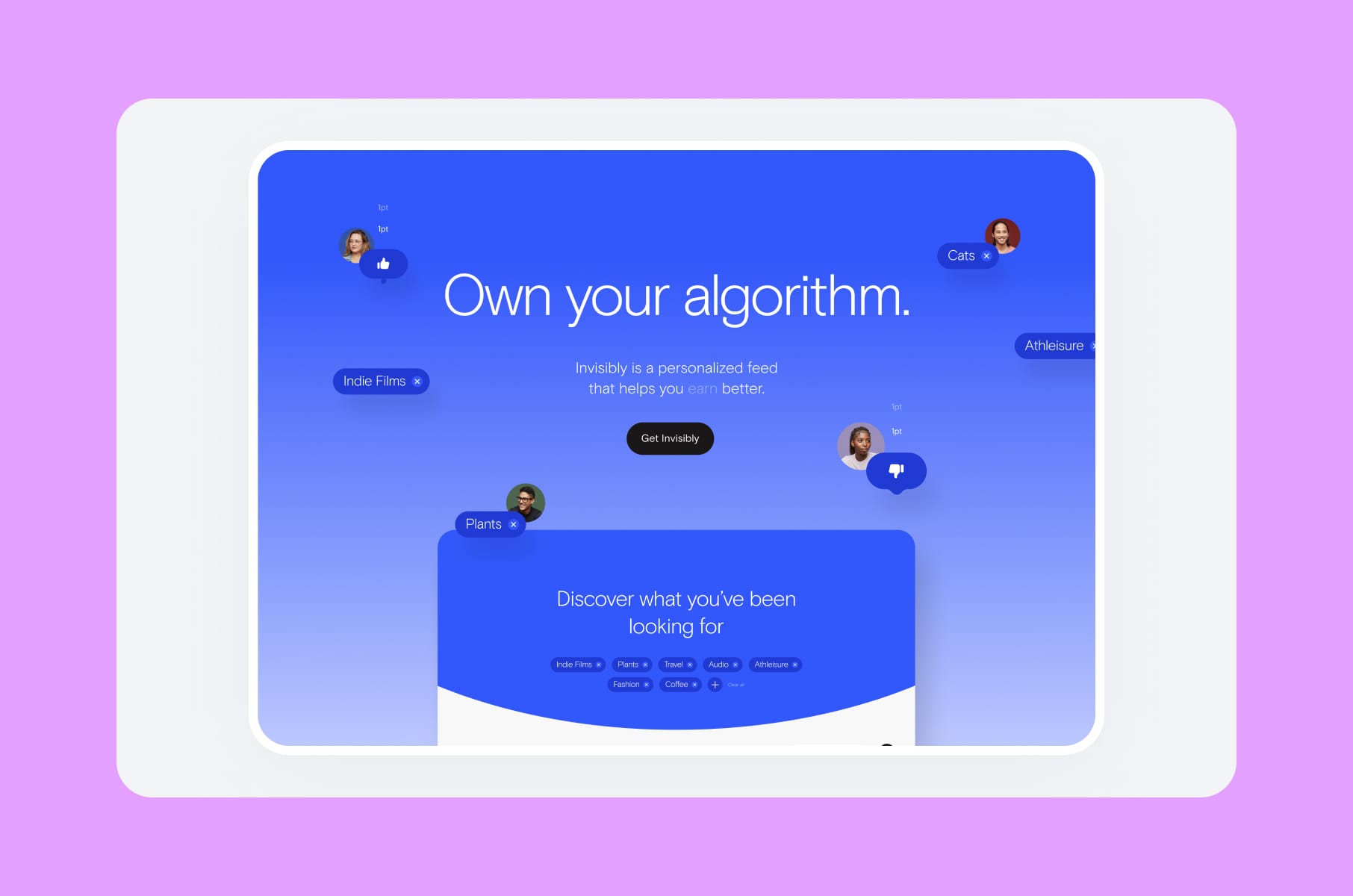
For Invisibly, the launch window was tight because the platform needed to land with B2C, B2B, and a Chrome extension at the same time. Sharing that window up front let us design the system, the dashboards, and the responsive interfaces in parallel rather than serially, which is the only way that schedule worked. (Invisibly case study)
What a good B2B web design agency does with your answers
Once you've answered these nine questions, the kickoff with a B2B web design agency sees some changes. Discovery gets faster because the agency isn't pulling answers from you in real time, and the proposal gets sharper because the scope is bounded. The first design round lands closer to the right, since the brief reflects reality rather than aspiration. Even change requests behave better - each one now has to be measured against an outcome you already wrote down.
For us at Merge, this is the difference between a six-week website project and a six-month one. We run a kickoff workshop, review competitor sites, and join a product walkthrough to understand the audience and goals, then define success metrics around messaging clarity, navigation, and ease of future updates. The faster we get the answers above, the faster that work starts producing value.
A good B2B web design services partner will also push back on you in healthy ways. If your ICP description is too broad, they'll ask you to narrow it. If your reference sites contradict your stated audience, they'll surface that. If your budget and launch window don't line up, they'll tell you which one needs to move. That's a partner, not a vendor.
Quick checklist before the first agency call
The quick version of this article, in case you want to print something and stick it to your monitor:
# | What to bring | Format |
1 | Primary outcome, plus one or two secondary outcomes | One sentence |
2 | ICP, including the buyer version the site is primarily for | One page |
3 | Analytics baseline, plus pages that cannot lose their URLs | 30-day GA snapshot |
4 | Success metrics for the 90 days after launch | Three to five numbers |
5 | Reference sites, sorted into love / structure / hate buckets | 3-5 links per bucket, with a "why" each |
6 | Tech and CMS constraints, including mandatory integrations | One-page doc |
7 | Content readiness audit | Sitemap with statuses, owners, dates |
8 | Single decision-maker, with a review SLA | A name and a number of days |
9 | Budget range and launch window | Two honest numbers |
If you hand this to a B2B website design agency on the first call, you will get proposals back faster, the proposals will actually be comparable, and the project that follows will be the kind that ships on time.
FAQ about hiring a B2B web design agency
How long does a B2B web design project usually take?
Most growth-stage B2B websites take 8 to 16 weeks from kickoff to launch, depending on page count, custom development, and content readiness. Small marketing sites can launch in 6 weeks. Enterprise-grade builds with localization and complex integrations can run 4 to 6 months. The biggest variable is rarely the design itself. It's the speed of content delivery and stakeholder reviews on your side.
How much does it cost to hire a B2B web design agency in 2026?
Public pricing data puts small B2B sites at $5k-$15k, growth-stage sites at $15k-$50k, and enterprise sites at $50k-$150k or more. Costs go up with custom development, motion design, multi-language support, complex integrations, and ongoing post-launch support. Sharing your real budget range up front gets you accurate proposals faster.
What should I include in a brief for a B2B web design agency?
At a minimum: your primary business outcome, your ICP, current analytics baseline, success metrics for 90 days post-launch, reference sites you like and dislike, your tech and CMS constraints, content readiness by page, your single decision-maker, your budget range, and your target launch window. That's the nine answers above, basically.
Should I hire a B2B web design firm or build the website in-house?
If you have a senior designer and a front-end engineer who are not busy with the product roadmap, in-house can work. Most B2B startups don't have that combination idle, and pulling product engineers onto the marketing site usually slows the product more than it speeds the site. A B2B web design firm earns its fee when it ships faster than your internal team would, with fewer trade-offs against the product roadmap.
How do I prevent scope creep with a B2B web design agency?
Three things:
- A clearly written brief with one primary outcome;
- The MoSCoW method on every feature list
- A defined change-request process in the contract.
New ideas in week four are fine. New ideas without a re-scoping process are how budgets blow up. Most experienced B2B website design agencies will already have this baked into their contract. If yours doesn't, ask for it.
What's the difference between a B2B web design agency and a B2B web development agency?
A B2B web design agency usually leads with research, brand, IA, and visual design, then builds in a CMS like Webflow or HubSpot. A B2B web development agency usually leads with engineering, custom builds (Next.js, headless CMS, custom integrations), and treats design as one input among several. Many agencies, like us at Merge, do both. The right choice depends on whether your project is mostly marketing-site-shaped or mostly custom-app-shaped.
Wrap-up
Hiring a B2B web design agency is one of the higher-stakes decisions a founder makes in a given year. The website is the artifact buyers look at before they ever talk to your sales team, and right now, most B2B buyers are doing that research entirely on their own, often through an AI tool. The site has to do its job without you in the room.
The good news is the founders who answer these nine questions before the first agency call almost always get the website they actually wanted, on a timeline they can defend, with a budget they actually authorized. That outcome comes down to preparation far more than luck.
Whatever you decide, our team at Merge would love to help. If you're ready to talk about your project, book a call with our B2B website design company, and we'll walk through your answers together. Stay tuned for more articles from us!